Brevian Meeting Prep is a pre-meeting intelligence engine that automatically generates structured, deal-aware briefing documents before every sales conversation. It synthesizes CRM data, prior transcripts, stakeholder history, and qualification frameworks into a seven-section brief covering interaction recaps, stakeholder mapping, pain-solution alignment, qualification gaps, deal risks, prioritized questions, and recommended outcomes. The system adapts between first meetings and follow-ups, and traces every insight back to specific data points. Meeting Prep joins Live Assist, Sales Coaching, and CRM Updates to cover the full lifecycle of sales conversations.
Meeting Prep: AI-Generated Pre-Call Intelligence

Your reps spend 30+ minutes preparing for important calls. What if that prep was already done, and better than anything they'd build manually?

Your reps spend 30+ minutes preparing for important calls. What if that prep was already done?
The sales intelligence market has no shortage of tools that record your meetings, transcribe them, and summarize what happened, which is genuinely useful after the fact but does nothing to help your reps before they walk into the room.
Think about what reps actually do before an important call: they spend 30 minutes tab-switching between the CRM, last meeting's notes, LinkedIn, and a half-remembered Slack thread from their SE, trying to piece together a picture of where the deal stands and what they should focus on. That preparation window is where deals are won or lost, and it's exactly where most tools leave reps entirely on their own.
Today, we're launching Meeting Prep in Brevian, a pre-meeting intelligence engine that automatically generates a structured, deal-aware briefing document before every sales conversation. There are no templates to fill out and no manual research to do. You open the meeting and the intelligence is already there waiting for you.
Meeting Prep uses Brevian's Knowledge Engine to pull together everything relevant to an upcoming meeting, including CRM data, prior transcripts, stakeholder history, qualification gaps, and deal risks, and synthesizes all of it into a single briefing that tells your rep where this deal stands, what's at risk, and the exact questions they need to ask in the next 30 minutes.
We built it around three principles that we believe separate useful pre-meeting intelligence from the generic briefings most tools produce.
Coherent. Every section of the briefing is aware of every other section, which means the qualification gaps directly inform the key questions, the deal risks shape the recommended outcomes, and the stakeholder map gives weight to the pain summary. It reads like a single briefing because it thinks like one, rather than feeling like separate outputs stitched together with no awareness of each other.
Comprehensive. Most reps preparing for a call will check one or two sources at best. Meeting Prep pulls from all of them at once: opportunity data, account history, every prior transcript, stakeholder engagement patterns, and your product knowledge base. A pain point mentioned by a technical buyer three meetings ago gets automatically linked to an unresolved objection from last week and a product capability your rep may not even know about yet.
Traceable. Every insight in Meeting Prep traces back to a specific data point, whether that's a quote from a transcript, a field in the CRM, or an engagement signal from a stakeholder. Reps can see exactly why a risk was flagged, and managers can see what evidence supports a qualification gap. Nothing in the briefing feels like a guess because nothing is.
The Eight-Section Briefing
The briefing itself is organized into seven sections, each designed to answer a question that a rep or manager would naturally ask before walking into a call.
Recap of Last Interactions pulls from the most recent transcript or email thread tied to the opportunity and generates a decision-ready summary covering key decisions, objections raised, action items with their current status, and open loops that need closing.
Stakeholder Map takes every attendee on the calendar invite, maps their role in the buying process (Champion, Economic Buyer, Technical Buyer, Influencer, or Blocker), and assigns a sentiment score based on evidence from prior meetings. For subsequent meetings, it tracks how sentiment has shifted, flags new attendees and what their presence likely means, and surfaces notable quotes and concerns. If a new VP of Engineering appeared on the invite and your Champion hasn't mentioned them before, you'll know about it and have context on what that might signal.
Pain Summary and Solution Mapping extracts every pain statement from your conversation history, attributes it to the person who said it, tracks whether it's active, addressed, or evolved, and maps each pain to the specific product capability that addresses it. Because Brevian has already ingested your product knowledge, that mapping is specific to your actual modules and differentiators rather than generic.
Qualification Gaps audits the deal against whatever framework your team runs, whether that's MEDDPICC, BANT, or something custom, flags fields that are missing or low-confidence, and generates targeted questions to fill each gap. Not a generic "Who is the economic buyer?" but a question informed by what's already known about the deal and the stakeholders involved.
Deal Risks evaluates the opportunity across six dimensions: engagement, competitive, stalled, technical, timeline, and champion. Each risk is scored by severity, backed by the evidence that triggered it, and paired with a mitigation strategy. If the deal has been in stage 40% longer than your team's benchmark, Meeting Prep flags that anomaly and suggests concrete next steps.
Key Questions is where the briefing converges into action, synthesizing qualification gaps, deal risks, stakeholder dynamics, and unresolved objections into 5 to 8 prioritized questions for this specific meeting. Each question is tagged by its strategic purpose: filling a gap, mitigating a risk, advancing the deal, resolving an objection, or validating your champion.
Recommended Outcomes defines what success looks like for this call, including stage-appropriate objectives, multi-threading recommendations, and a specific next step to secure before the conversation ends.
Helpful Resources surfaces sales enablement material that you might find helpful like a case study in a similiar industry and potential use case or a product brief covering the new POC in a similiar application
Adaptive Intelligence
Not every meeting is the same, and Meeting Prep doesn't treat them that way. The system automatically detects whether this is a first meeting or a subsequent meeting based on prior interaction history and adapts the output accordingly. First meetings emphasize company intelligence, industry context, hiring signals, and initial pain hypotheses. Subsequent meetings activate the full seven-section briefing with deep context on what's been discussed, how the conversation has evolved, and what needs to happen next. When sections don't have enough data to be meaningful, they return empty rather than filling space with speculation.
Who Benefits
AEs and SEs can stop spending 30 minutes on pre-call research and walk in with a strategic plan rather than background context. Sales Managers can review upcoming meetings across their team in minutes and spot deals where reps are about to walk into calls unprepared. RevOps and Enablement get methodology enforcement without added friction, since qualification gaps surface automatically rather than through constant reminders to update CRM fields.
Part of the Full Brevian Platform
Meeting Prep joins Live Assist (real-time guidance during calls), Sales Coaching (post-call analysis), and CRM Updates (automated data hygiene) to cover the full lifecycle of a sales conversation. Because every feature draws from the same Knowledge Engine, intelligence is consistent across touchpoints and compounds over time as the platform learns more about your deals, your customers, and your product.
Meeting Prep is available now for all Brevian customers, and if you're not on the platform yet, you can request a demo to see how it works with your data, your deals, and your methodology.
Brevian is the knowledge-powered sales intelligence platform that bridges the gap between product innovation and sales execution. Learn more at brevian.ai.
FAQ
What is Brevian Meeting Prep?
Brevian Meeting Prep is an AI-powered pre-meeting intelligence feature that automatically generates structured briefing documents before sales meetings by synthesizing CRM data, prior transcripts, stakeholder history, and qualification frameworks into a seven-section strategic brief.
How is Meeting Prep different from AI meeting notes tools?
Most AI meeting tools focus on what happens after a call, producing transcripts, summaries, and action items. Brevian Meeting Prep focuses entirely on what happens before by analyzing deal context, identifying risks, surfacing qualification gaps, and recommending specific questions and outcomes for the upcoming conversation.
How are sales frameworks supported?
Meeting Prep works with whatever qualification framework your team already runs, whether that's MEDDPICC, BANT, or a custom methodology, by automatically auditing deals against your framework and generating targeted questions to fill each gap.
How does Meeting Prep handle first meetings vs. follow-up meetings?
Meeting Prep automatically detects meeting type based on prior interaction history, with first meetings emphasizing company intelligence and stakeholder context while subsequent meetings include full deal analysis with recaps, pain evolution, qualification gaps, and risk assessment.
What data does Meeting Prep use?
Meeting Prep draws from your CRM opportunity and account data, calendar attendees, prior meeting transcripts and summaries, stakeholder engagement history, and Brevian's Knowledge Engine, which includes your product knowledge, solution mappings, and sales methodology.
If you liked this, you might want to read
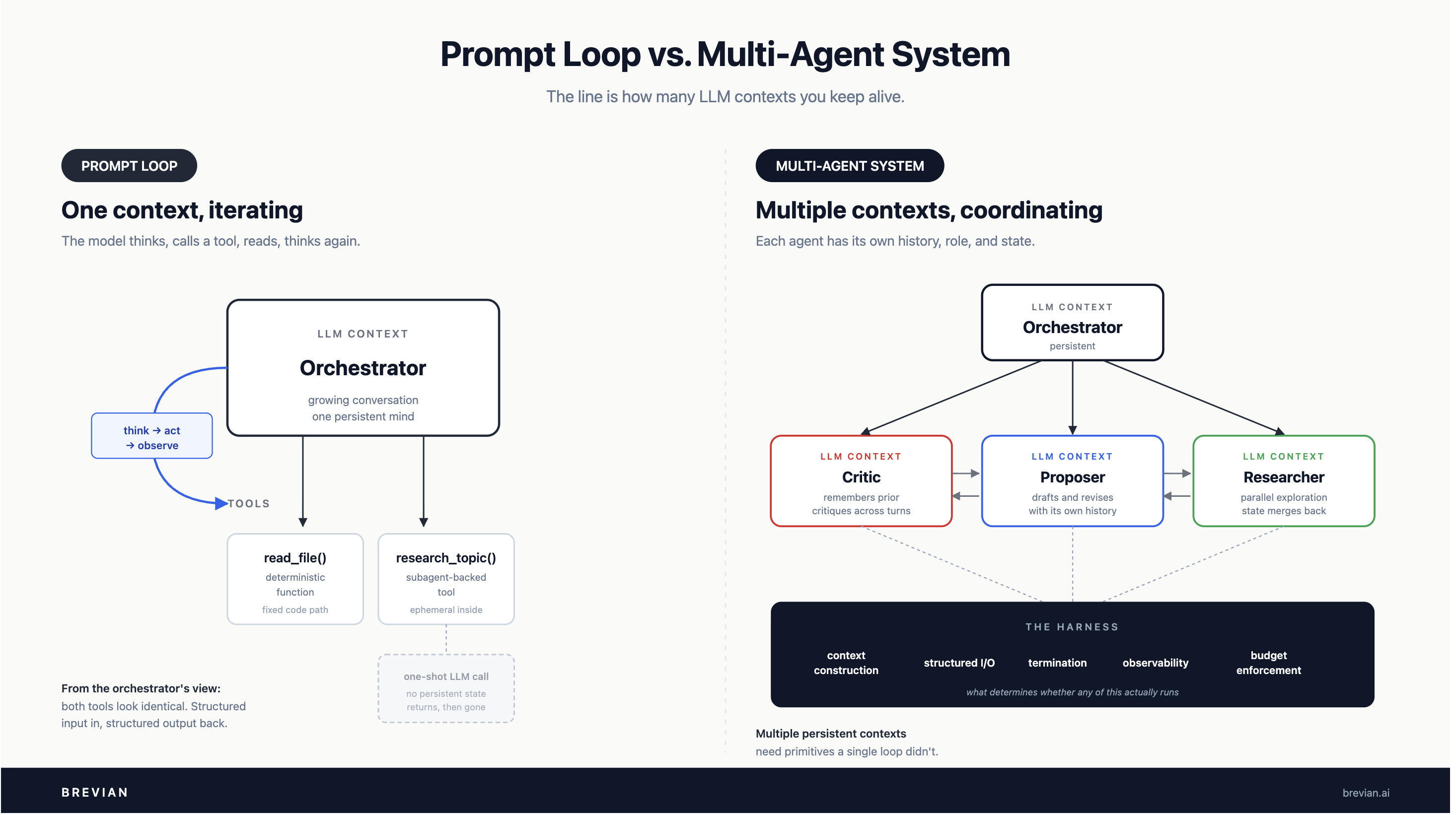
From Prompt Loops to Multi-Agent Systems: Why the Harness Matters
Where the line between a prompt loop and a multi-agent system actually sits, and what that implies for the harness you have to build underneath.
Introducing Brevian MCP: Ask Your Sales Data Anything
New intelligence, synthesized from every layer of your sales data, delivered as operational playbooks you can act on this week.
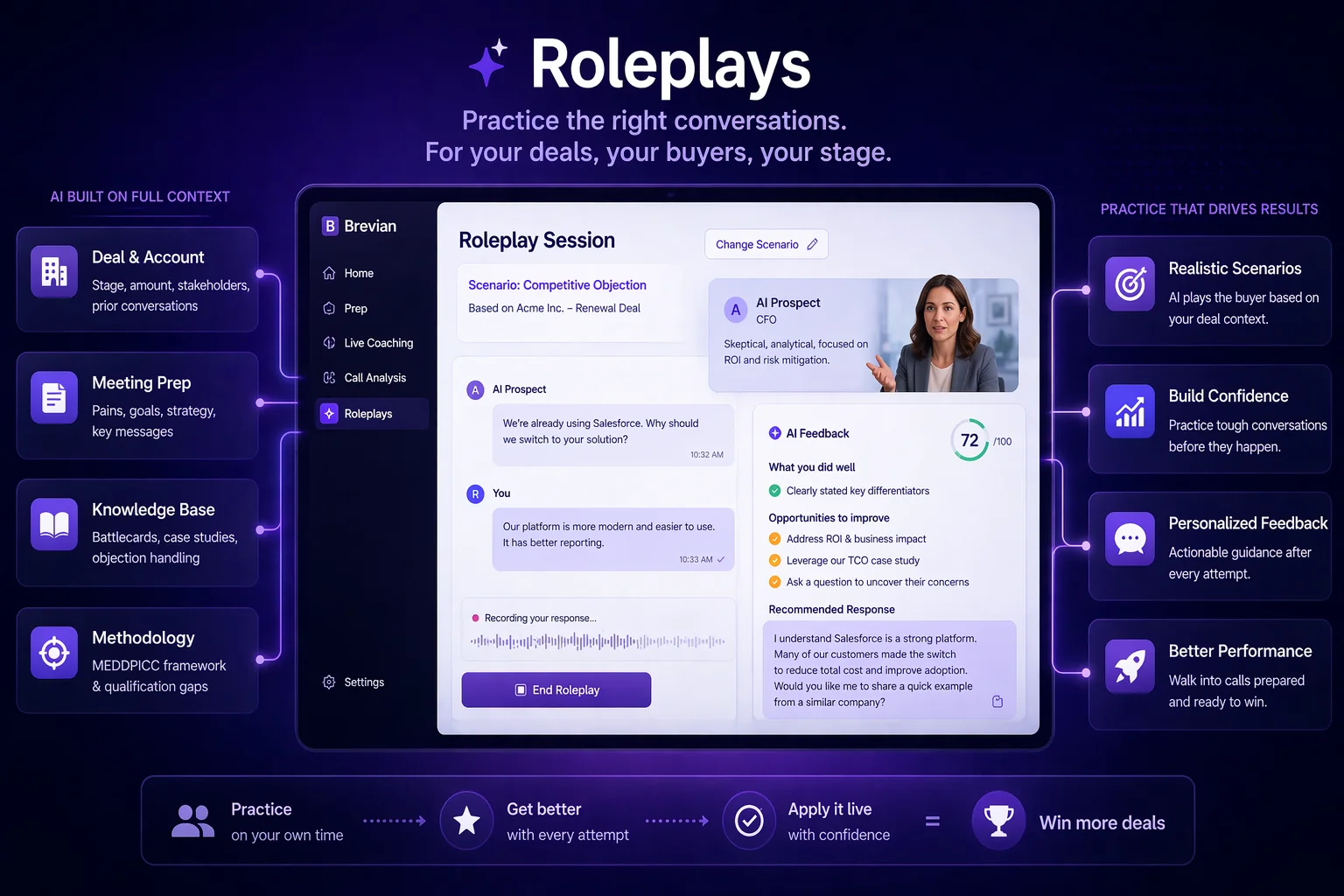
Practice the Call Before It Happens
Every high-performance profession has structured practice. Sales is the exception. Brevian Roleplays let reps rehearse deal-specific scenarios grounded in real context.