Brevian Deal Review is an AI-powered deal assessment feature that synthesizes meeting conversations, MEDDPICC data, CRM activity, and stakeholder engagement into a structured six-section analysis of deal health. It provides an executive summary, champion analysis, risk factor catalog with evidence, buyer urgency assessment, qualification gap audit, and prioritized recommended actions. The system adapts to deal stage and regenerates after every linked meeting, replacing opinion-driven pipeline reviews with evidence-based intelligence.
Deal Review: Deal Analysis That Actually Changes Rep Behavior

Your AE says the deal is on track. Your pipeline says it's on track. But neither has actually looked at the evidence. Deal Review replaces opinion-driven pipeline reviews with AI-powered deal intelligence.

Ask any AE how their top deal is going and you'll get a confident answer. Ask them to prove it and you'll get silence.
Every sales manager knows the ritual. You sit down for pipeline review, your AE walks you through the deal, and the update sounds reasonable enough: "MEDDPICC checks off, Champion is engaged, next steps are clear, close date is on track." But the assessment is built entirely on memory and optimism, not on evidence, and you both know it. The problem is that neither of you has time to do anything about it.
AEs manage 15 to 30 active deals simultaneously, and the signals that actually determine whether a deal closes or stalls are scattered across meeting transcripts, CRM fields, email threads, and Slack conversations. Manually assembling a clear picture of any single deal takes 15 to 20 minutes of context-switching. Doing that across an entire pipeline before a weekly review is simply not realistic, so managers end up relying on the same gut-feel reporting they know is unreliable, and AEs end up surprised by deals that slip, stall, or disappear.
The result is that pipeline reviews become performative rather than productive. Managers ask questions they already know the answers to, AEs give updates that sound good but lack specificity, and the deals that actually need intervention don't surface until it's too late to intervene.
That is why we built Deal Review in Brevian, an AI-powered deal assessment that synthesizes meeting conversations, MEDDPICC data, CRM activity, and stakeholder engagement into a structured analysis of every deal in your pipeline. Deal Review is Brevian's deal intelligence feature that automatically generates evidence-based assessments of deal health, risk, and recommended next steps, replacing opinion-driven pipeline reviews with impartial analysis grounded in what actually happened in the room.
We built it around three principles that separate actionable deal intelligence from generic CRM dashboards.
Evidence-based. Every signal in the assessment traces back to something that was actually said, measured, or observed. When Deal Review flags a champion risk, it cites the specific meeting where engagement dropped. When it identifies a qualification gap, it tells you exactly which MEDDPICC element is missing and what evidence (or lack of evidence) triggered the flag. Managers stop asking "how do you know?" because the answer is already in front of them.
Contextual. A deal in discovery and a deal in negotiation have completely different risk profiles, and the system accounts for that. Deal Review pulls stage history, deal age, days since last activity, and meeting cadence to weight its analysis appropriately. A deal that hasn't had a meeting in two weeks might be healthy in early stages and alarming in late ones, and the assessment reflects that distinction rather than applying a single threshold everywhere.
Prioritized. Not every deal needs the same level of attention on any given day, and the system makes that explicit. The assessment surfaces the most critical risks, the highest-impact qualification gaps, and the next steps that will actually move the deal forward, so managers can scan a full pipeline quickly and know exactly which deals need intervention today. The prioritization is driven by the full body of evidence across the assessment rather than any single metric, so it catches compound risk that no individual data point would surface on its own.
The Six-Section Assessment
The assessment itself is organized into six sections, each designed to answer a question that an AE or manager would naturally ask during a deal review.
Executive Summary delivers a 30-second read on where the deal stands. It covers overall health in two to three sentences, identifies the key strength and the primary concern, and makes an explicit assessment of whether the current close date is achievable. This is the section managers read first and the section AEs use to prepare for pipeline reviews in minutes rather than hours.
Champion Analysis maps who the champion is, what their influence level looks like based on meeting participation and responsiveness, what risks exist around their status (role changes, competing priorities), and what the AE should do to strengthen or protect the relationship. If your champion hasn't attended the last two calls, or if a new stakeholder appeared on the invite who could signal an evaluation reset, this section surfaces it with context rather than just a flag.
Risk Factors catalogs every deal risk identified across conversations, organized by category: budget and financial, competitive, timeline, stakeholder, and technical. Each risk includes the specific evidence that triggered it (a quote or paraphrase from a meeting transcript), a severity rating, and a concrete mitigation recommendation. This turns vague concerns into specific actions.
Buyer Urgency assesses whether the prospect has a real reason to buy on the current timeline. It identifies compelling events (contract renewals, new initiatives, regulatory deadlines), evaluates the cost of inaction from the buyer's perspective, and flags deals where urgency is assumed rather than validated. This section is where forecast accuracy lives or dies.
Qualification Gaps displays MEDDPICC completion as both a percentage and a dimension-by-dimension breakdown showing exactly what's been validated, what's partially known, and what's completely missing. Each gap comes with a targeted question designed to fill it in the next conversation, informed by what's already been discussed so the AE doesn't re-ask something that was covered three meetings ago.
Recommended Actions is where the assessment converges into a prioritized action plan. It surfaces three to five specific next steps, each tagged by priority (high or medium), with an explanation of why the action matters and a recommended timeline. "Schedule CFO intro meeting before champion's role transition" is the kind of output that changes deal outcomes, not "follow up with stakeholders."
Adaptive Intelligence
The system adapts based on deal context in ways that static reports never could. A first-stage deal gets an assessment weighted toward qualification completeness and initial stakeholder mapping. A late-stage deal gets an assessment weighted toward decision process clarity, paper process readiness, and close date risk. Deals with recent meeting activity get richer signal analysis while deals that have gone quiet get velocity-focused alerts. And because Deal Review regenerates after every meeting linked to a deal, as well as on a nightly refresh cycle, the assessment evolves with the deal rather than representing a point-in-time snapshot.
Who Benefits
AEs can stop spending 15 to 20 minutes assembling deal context and walk into pipeline reviews with a ready-made, evidence-backed assessment that their manager already trusts. Sales Managers can review 40 deals in an hour instead of four, spending their time on the five deals that actually need coaching rather than manually triaging every opportunity. RevOps gets a consistent evaluation framework applied to every deal automatically, which means pipeline hygiene improves without adding process friction or yet another field for reps to fill out.
Part of the Full Brevian Platform
Deal Review joins Meeting Prep (pre-meeting intelligence), Live Assist (real-time guidance during calls), and CRM Updates (automated data hygiene) to cover the full lifecycle of a sales conversation. Because every feature draws from the same Knowledge Engine, the evidence surfaced in a Deal Review assessment is the same evidence that informed your Meeting Prep briefing and the same evidence that will update your CRM fields after the call. Brevian is the knowledge-powered sales intelligence platform that makes intelligence compound across every touchpoint rather than fragmenting it across disconnected tools.
Deal Review is available now for all Brevian customers. Request a demo to see how it works with your pipeline, your methodology, and your deals.
Brevian is the knowledge-powered sales intelligence platform that bridges the gap between product innovation and sales execution. Learn more at brevian.ai.
FAQ
What is Brevian Deal Review?
Brevian Deal Review is an AI-powered deal assessment feature that automatically generates structured, evidence-based analyses of deal health by synthesizing meeting conversations, MEDDPICC data, CRM activity, and stakeholder engagement into a six-section report with champion analysis, risk factors, qualification gaps, and prioritized next steps.
How is Deal Review different from CRM deal dashboards?
CRM dashboards display the data your reps enter manually, which means they reflect what reps believe (or want managers to believe) about deal status. Deal Review analyzes what actually happened in conversations, cross-references it against qualification frameworks and activity patterns, and produces an independent assessment grounded in evidence rather than self-reporting.
How does Deal Review handle deals at different stages?
Deal Review adapts its analysis based on deal context including current stage, deal age, time in stage, and activity patterns. Early-stage deals are weighted toward qualification completeness and stakeholder mapping while late-stage deals are weighted toward decision process clarity, paper process readiness, and close date achievability.
How often is Deal Review updated?
Deal Review regenerates automatically after every meeting linked to a deal is processed, runs nightly refreshes for all active deals, and can be regenerated on demand at any time. This means the assessment always reflects the most recent conversation and deal activity rather than a static snapshot.
What data does Deal Review use?
Deal Review draws from meeting transcripts and summaries, CRM opportunity and account data, MEDDPICC qualification data, activity history, stage history, contact engagement patterns, and prior Deal Review assessments to track how deal health is evolving over time.
If you liked this, you might want to read
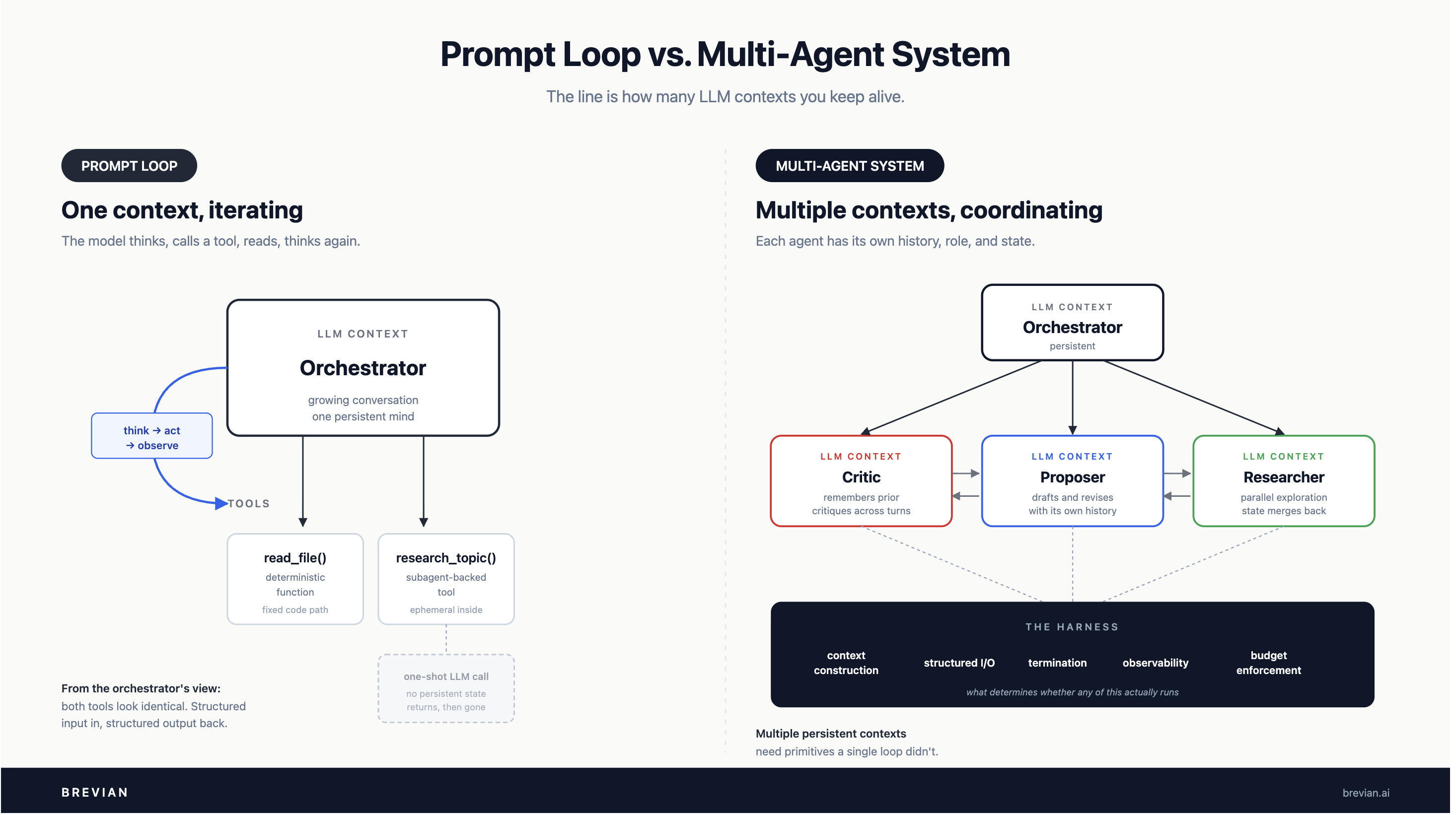
From Prompt Loops to Multi-Agent Systems: Why the Harness Matters
Where the line between a prompt loop and a multi-agent system actually sits, and what that implies for the harness you have to build underneath.
Introducing Brevian MCP: Ask Your Sales Data Anything
New intelligence, synthesized from every layer of your sales data, delivered as operational playbooks you can act on this week.
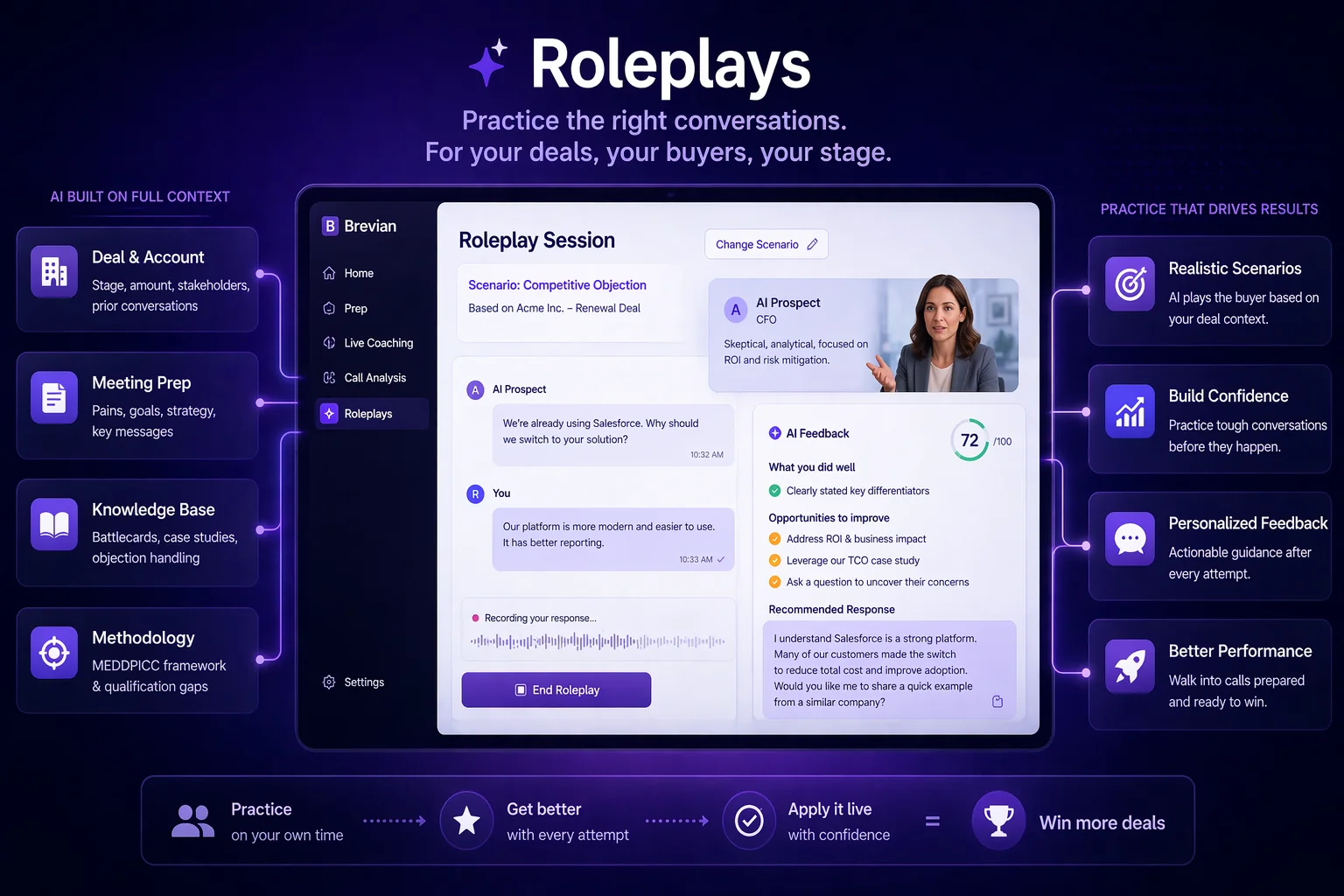
Practice the Call Before It Happens
Every high-performance profession has structured practice. Sales is the exception. Brevian Roleplays let reps rehearse deal-specific scenarios grounded in real context.