Brevian CRM Updates is a bidirectional CRM synchronization feature that automatically extracts MEDDPICC qualification data from sales conversations and pushes it to Salesforce or HubSpot. It captures qualification evidence consistently across every meeting, monitors how each MEDDPICC dimension evolves over time, makes framework adoption visible in real time, and maintains full provenance for every CRM entry. The feature connects to Meeting Prep, Deal Review, and Live Assist so that methodology enforcement compounds across every stage of the deal cycle.
CRM Updates: Put Your Sales Methodology in the CRM
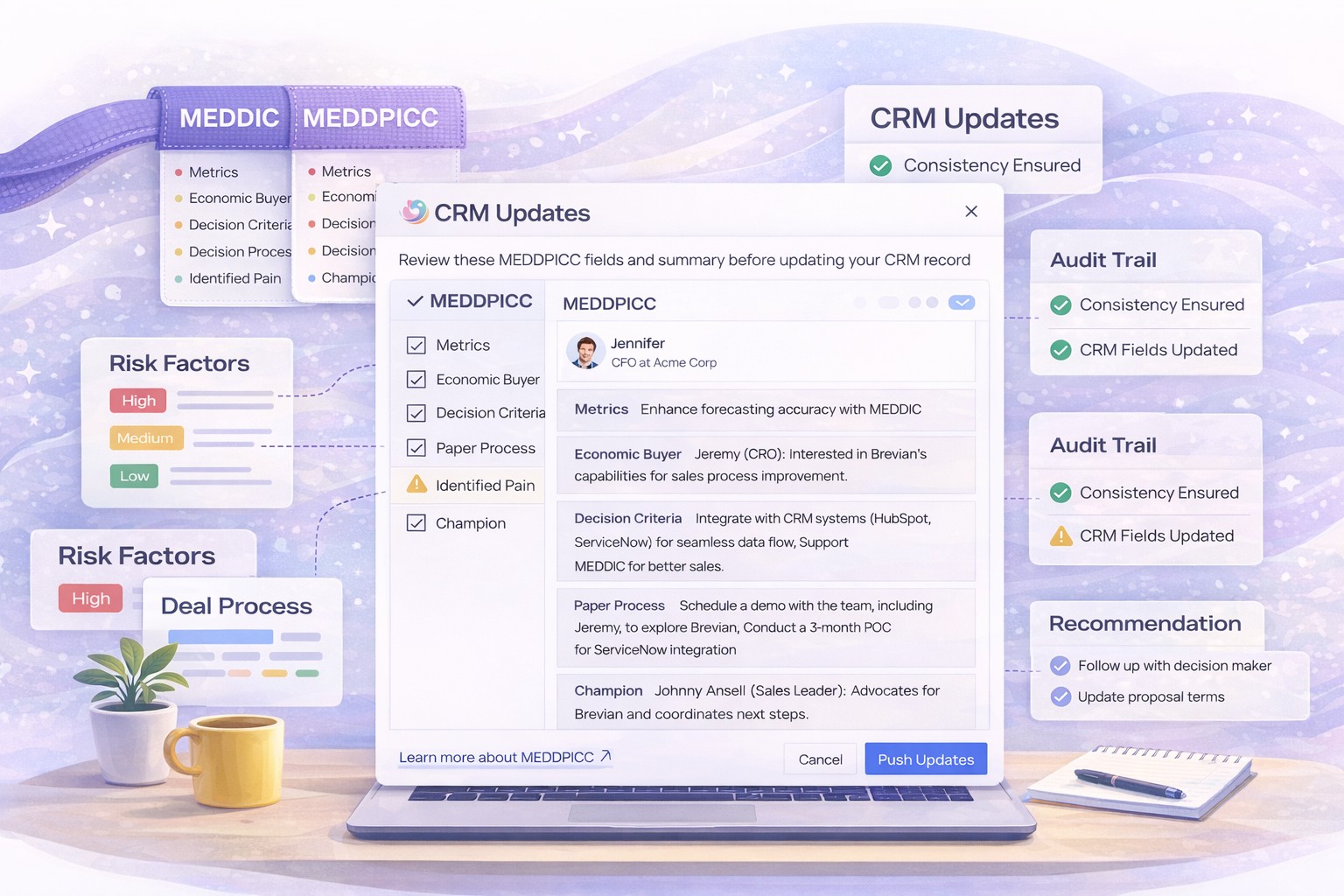
Every sales org adopts a framework. Almost none can prove their reps are actually following it. CRM Updates keeps your sales methodology reflected in Salesforce or HubSpot automatically.

Every sales org adopts a framework. Almost none can prove their reps are actually following it, and the CRM is where that gap becomes permanent.
Most sales organizations will tell you they run MEDDPICC, or MEDDIC, or BANT, or some custom variant that leadership spent months designing and rolling out. The framework gets introduced at SKO, reinforced during onboarding, printed on laminated cards, and referenced in every training session. And then it hits the field, where it quietly dies in the space between what reps learn and what they actually record.
The reason is not that reps don't understand the framework. It's that following it requires a second layer of work that has nothing to do with selling. After every call, someone has to translate what was discussed into structured CRM fields: who the economic buyer is, what the decision criteria are, whether a champion has been identified. That translation step is manual, time-consuming, and entirely disconnected from the conversation where the information actually surfaced. So reps skip it, or fill in what they remember a few days later, or populate fields with vague one-liners that satisfy the checkbox without capturing anything useful.
The result is a CRM that technically has MEDDPICC fields but functionally doesn't reflect the methodology at all. Managers can't trust what's in there because they know it was entered from memory rather than evidence. Rev ops can enforce it, but accuracy doesn’t change and often requires them to listen to calls themselves. And the framework that was supposed to create consistency across the org becomes something reps think about during deal reviews and forget about everywhere else.
That is why we built CRM Updates in Brevian, a bidirectional sync between your conversations and your CRM that automatically captures MEDDPICC qualification from every meeting, lets reps review and refine it, and pushes it to your system of record in a single action. CRM Updates is Brevian's automated CRM synchronization feature that keeps your sales methodology reflected in Salesforce or HubSpot by extracting qualification data, meeting summaries, and action items directly from conversations rather than relying on manual entry.
But calling it a sync feature undersells what it actually does. What makes CRM Updates different is that it treats your sales framework as the connective tissue that runs through every feature in Brevian, not as a set of fields that need populating.
Consistent. When Brevian processes a meeting transcript, it doesn't just generate a summary. It identifies which MEDDPICC elements were discussed, extracts the specific evidence for each (a quote about budget constraints maps to Metrics, a mention of the CFO's approval process maps to Decision Process), and attributes every insight to the person who said it and the meeting where it happened. This happens on every call, for every deal, using the same extraction logic, which means your qualification data is captured with the same rigor whether the AE is a ten-year veteran or someone in their second week.
Monitored. Because qualification is extracted continuously rather than logged retroactively, Brevian can track how each MEDDPICC dimension evolves across meetings. A Champion field that was strong three calls ago but hasn't been reinforced since gets flagged, not as an empty field, but as a signal that confidence in the champion may be eroding. Decision Criteria that shifted between the second and fourth meetings surface as an evolution rather than a static entry. This is the difference between a CRM that stores what reps typed and a system that reflects what actually happened across the entire deal cycle.
Enforceable. The biggest challenge with any sales methodology is that adoption is invisible until a deal is lost. Managers only discover that reps weren't following the framework when the post-mortem reveals an economic buyer was never identified or a paper process was never mapped. CRM Updates makes framework adoption visible in real time. Qualification gaps surface in Deal Review assessments, inform the questions generated by Meeting Prep, and get addressed during calls with Live Assist. The framework isn't a training artifact that reps might or might not apply, it's woven into every stage of the deal.
Traceable. Every MEDDPICC entry that reaches your CRM through Brevian carries provenance. You can see which meeting the insight was extracted from, who said it, and what the exact context was. When a manager reviews a deal and sees "Decision Process: CFO requires board approval for purchases over $500K, procurement review takes 3-4 weeks" in Salesforce, they can trace that back to the specific conversation where the prospect shared it. This transforms MEDDPICC fields from opinion boxes into evidence records.
The mechanics of how this works are designed to be invisible. After each meeting, Brevian's MEDDPICC processor analyzes the transcript alongside every other conversation linked to that opportunity. It merges new insights with existing qualification data, detects changes from what's currently in your CRM, and presents a side-by-side comparison showing the AI-generated summary next to your current CRM values. The AE reviews it, makes any edits they want (because they have context the system might not), and pushes to CRM in a single click. MEDDPICC fields, meeting summary, and action items all land in Salesforce or HubSpot at once.
What doesn't happen is equally important. The AE doesn't open Salesforce. They don't try to remember what was discussed. They don't retype information that already exists in a transcript. They don't skip the update because they're rushing to their next call. The gap between "information surfaced in a conversation" and "information reflected in the CRM" shrinks from days to minutes, and the quality of what reaches the CRM improves dramatically because it's grounded in what was actually said rather than what someone remembered to type.
This matters beyond just CRM hygiene because the framework data that CRM Updates maintains is the same data that powers every other feature in Brevian. When Meeting Prep generates a briefing before your next call, the qualification gaps it identifies come from the MEDDPICC data that was extracted from real conversations and synced to your CRM. When Deal Review flags a risk, the evidence behind that risk traces back to the same conversation-level data. When Live Assist suggests a question during a call, it's because the framework analysis identified a dimension that still needs validation. The methodology isn't a separate workflow. It's the fabric that connects preparation, execution, and follow-through into a single coherent system.
For an organization running MEDDPICC, this means the framework finally works the way it was designed to. Every conversation contributes to qualification. Every qualification gap informs the next conversation. Every CRM field reflects evidence rather than opinion. And every pipeline review can reference data that managers actually trust, because they can see exactly where it came from.
AEs get their evenings back. The hours spent on manual CRM updates after a day of calls compress into a quick review-and-push after each meeting, with the hard work of extracting qualification data already done. Sales Managers get methodology compliance without being the compliance police, because framework adherence becomes visible through the data rather than through interrogation during pipeline reviews. RevOps gets the clean, consistent, evidence-backed CRM data they've always wanted, without adding another process step that reps will resent and eventually ignore.
CRM Updates joins Meeting Prep (pre-meeting intelligence), Deal Review (AI-powered deal assessment), and Live Assist (real-time guidance during calls) as part of the full Brevian platform. Because every feature draws from the same Knowledge Engine and the same conversation data, the methodology enforcement that CRM Updates enables compounds across every touchpoint. Brevian is the knowledge-powered sales intelligence platform where your sales framework isn't just a training concept but the operating system for how your team sells.
CRM Updates is available now for all Brevian customers using Salesforce or HubSpot. Request a demo to see how it works with your methodology, your CRM, and your deals.
Brevian is the knowledge-powered sales intelligence platform that bridges the gap between product innovation and sales execution. Learn more at brevian.ai.
FAQ
What is Brevian CRM Updates?
Brevian CRM Updates is a bidirectional CRM synchronization feature that automatically extracts MEDDPICC qualification data, meeting summaries, and action items from sales conversations and pushes them to Salesforce or HubSpot, keeping your system of record aligned with what actually happens in meetings rather than relying on manual data entry.
How does CRM Updates handle MEDDPICC?
After each meeting, Brevian's MEDDPICC processor analyzes the transcript alongside all prior conversations for that opportunity, extracts evidence for each qualification dimension (Metrics, Economic Buyer, Decision Criteria, Decision Process, Paper Process, Identify Pain, Champion, Competition), merges new insights with existing data, and presents a side-by-side comparison against current CRM values for the AE to review and push.
Which CRMs does Brevian integrate with?
Brevian currently integrates with Salesforce (via OAuth and JWT authentication) and HubSpot (via OAuth authentication). Both integrations support bidirectional sync, with automated data pulls on a configurable schedule and user-driven pushes for MEDDPICC data, meeting summaries, and action items.
Does CRM Updates work with custom sales frameworks?
CRM Updates works with MEDDPICC, MEDDIC, BANT, and custom qualification frameworks. Organizations can configure custom field mappings between Brevian's extracted data and their specific CRM fields, so the system adapts to your methodology and field structure rather than requiring you to adopt a new one.
How does CRM Updates connect to other Brevian features?
The MEDDPICC data that CRM Updates maintains powers every other feature in Brevian. Meeting Prep uses it to identify qualification gaps before calls. Deal Review uses it to assess deal health and flag risks. Live Assist references it to suggest questions during conversations. This creates a continuous loop where every meeting strengthens qualification and every qualification gap informs the next meeting.
What data does CRM Updates sync automatically?
Brevian automatically pulls pipeline stages, accounts, contacts, opportunities, contact roles, tasks, events, emails, and opportunity history from your CRM on a configurable schedule. Users can push MEDDPICC summaries, meeting summaries, and action items back to CRM after reviewing and approving the AI-generated content.
If you liked this, you might want to read
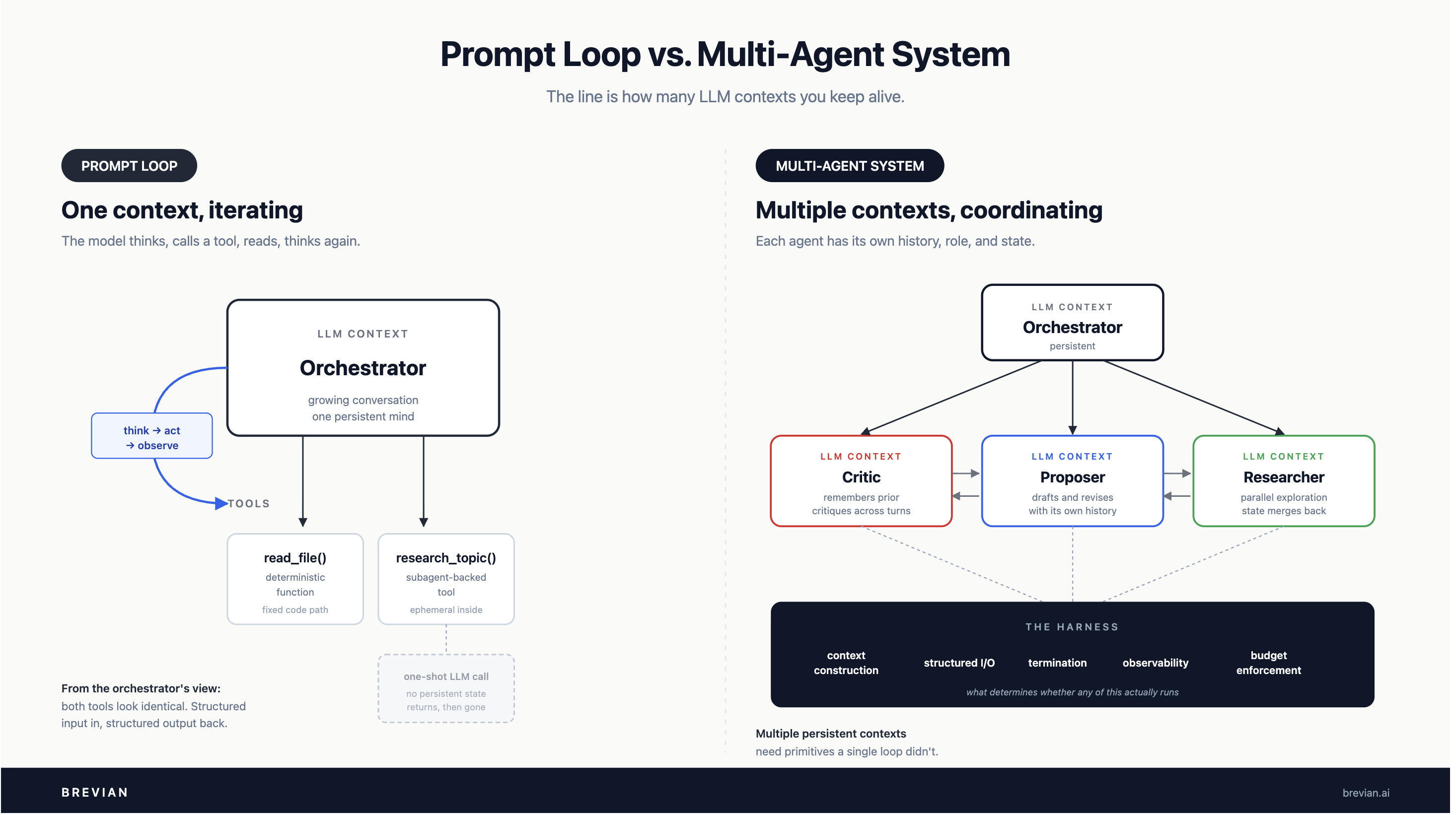
From Prompt Loops to Multi-Agent Systems: Why the Harness Matters
Where the line between a prompt loop and a multi-agent system actually sits, and what that implies for the harness you have to build underneath.
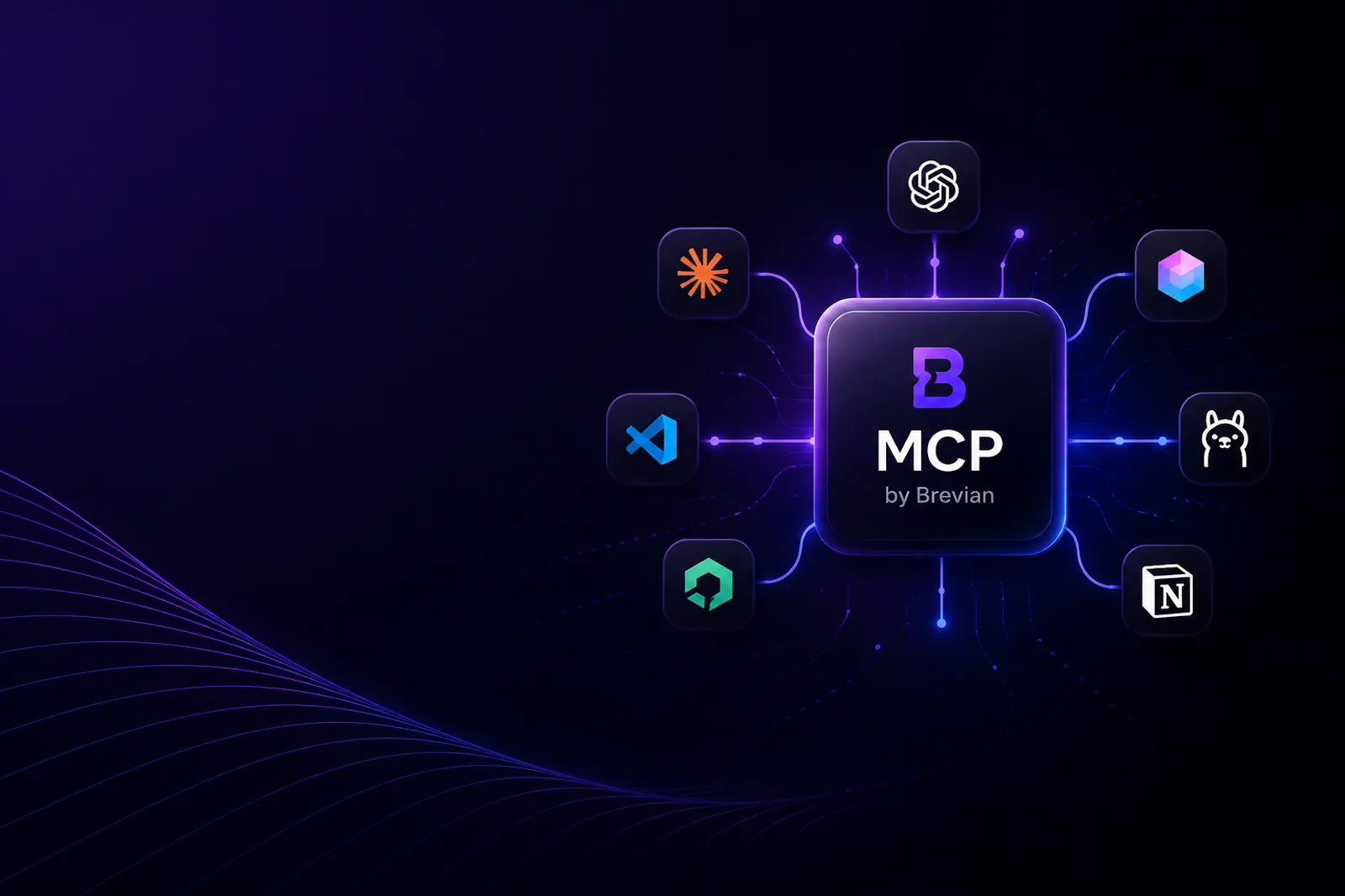
Introducing Brevian MCP: Ask Your Sales Data Anything
New intelligence, synthesized from every layer of your sales data, delivered as operational playbooks you can act on this week.
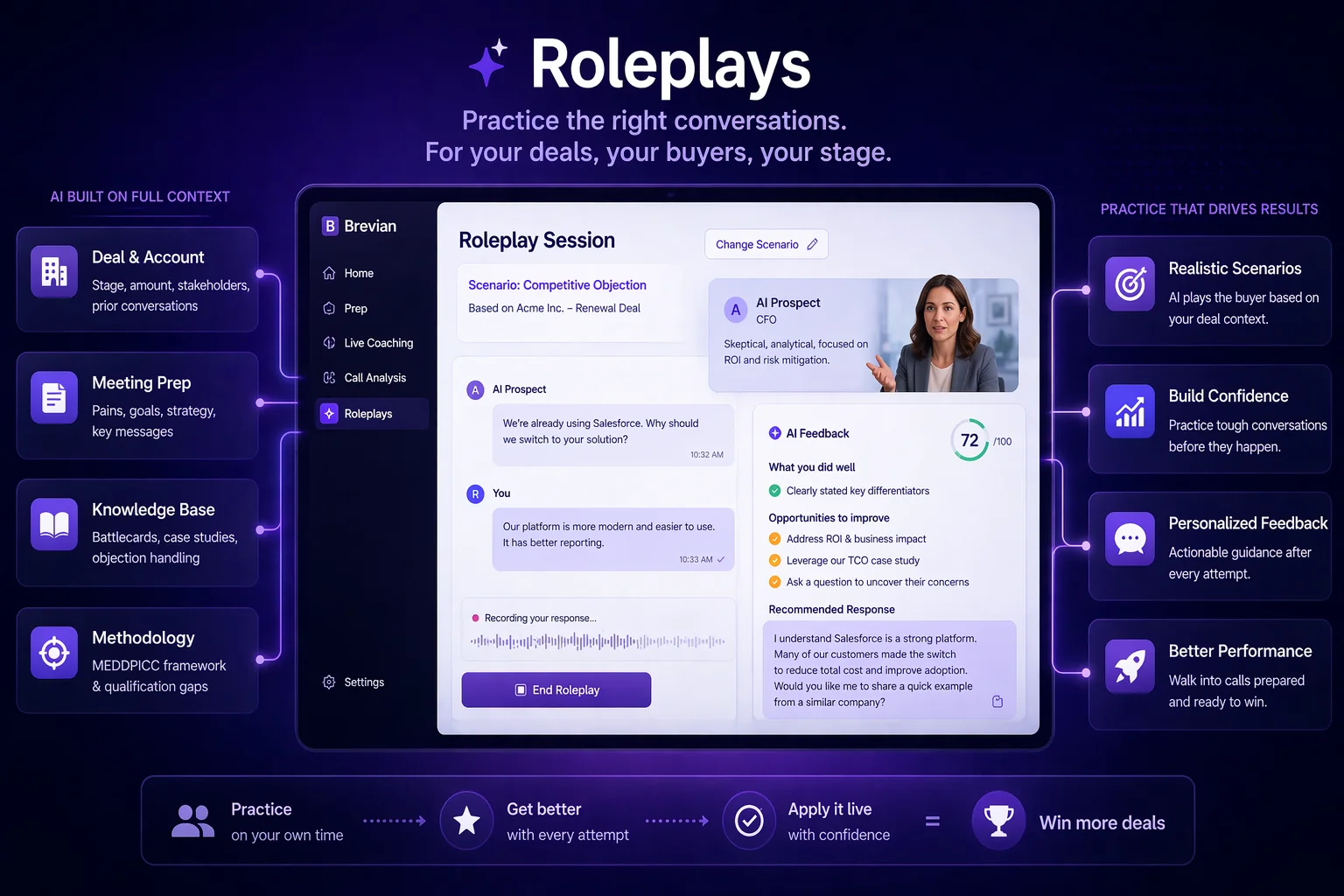
Practice the Call Before It Happens
Every high-performance profession has structured practice. Sales is the exception. Brevian Roleplays let reps rehearse deal-specific scenarios grounded in real context.