Brevian Coaches the Deal, Not Just the Call
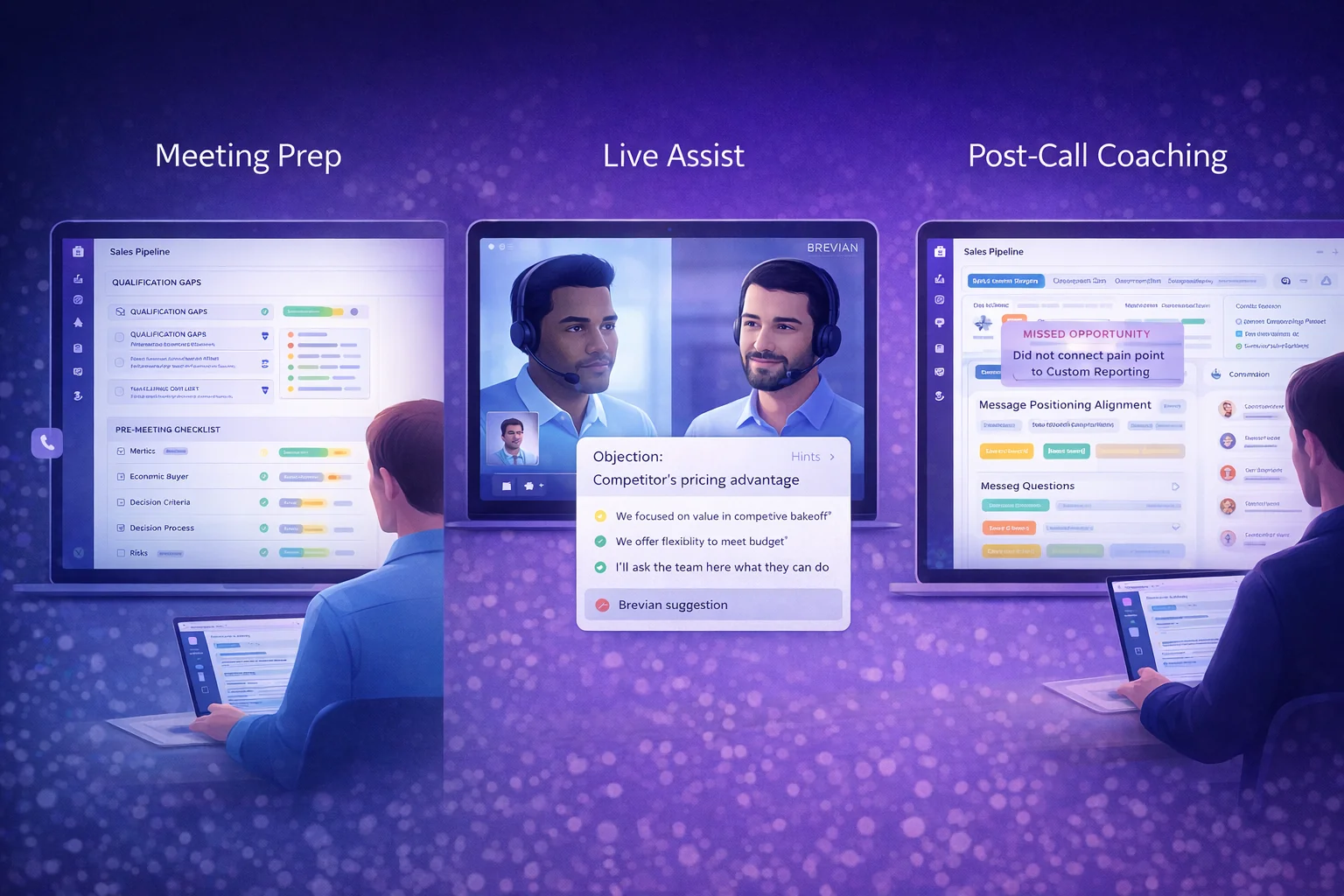
Most sales coaching is retrospective. Brevian coaches before the call with Meeting Prep, during it with Live Assist, and after with Sales Coaching, all from the same Knowledge Engine.

Post-call coaching solves for the wrong moment. The conversation that needed to go differently is already over.
Every rep has had the experience of reading their post-call feedback and thinking: I know. The discovery question they should have asked. The competitive objection they fumbled. The moment the prospect mentioned a pain that connected directly to a product capability the rep never surfaced. The feedback arrives the next morning and it is accurate and it is useless, because the call ended sixteen hours ago and the next one starts in forty-five minutes.
This is the structural problem with most sales coaching: it is retrospective by design. It tells reps what went wrong after the moment it would have helped. Brevian is built on the premise that coaching should happen before the call, during it, and after it, and that all three moments need to share the same intelligence to compound rather than repeat themselves.
Before and During
Meeting Prep is where coaching starts. Before every call, Brevian generates a structured brief from the deal's full history: the MEDDPICC gaps that exist going into this conversation, the risks that need addressing, the stakeholder dynamics that have shifted, the questions most likely to advance the deal at this stage. The rep arrives knowing what this call requires and why, grounded in what has been confirmed across every prior meeting.
Live Assist is where coaching happens in the moment. When a competitor gets mentioned, when a prospect expresses a pain the rep has not yet connected to a product capability, when a MEDDPICC gap appears in the conversation, Live Assist surfaces a card with what to say, what to ask, and which assets are relevant right now. The guidance draws from the same Knowledge Engine as the pre-meeting brief: your actual battlecards, your actual use cases, the actual context of this deal. Noise controls gate assists to no more than once every sixty seconds and track what has already been addressed, so the rep feels supported rather than interrupted.
After: Where the Depth Lives
Sales Coaching is the post-call layer, and what separates it from every transcript-based coaching tool is the context it brings to the analysis. It does not just read what was said. It reads the call in the context of where the deal stands in the CRM, what MEDDPICC looked like going in versus coming out, what prior meetings established about this prospect's pains and objections, what the pre-meeting prep recommended the rep cover, and what your product knowledge base says the correct response to each signal actually was. With all of that assembled, it can answer the question that transcript analysis alone cannot: not just what happened, but what should have happened and did not.
Three capabilities follow from that architecture.
Missed Opportunities Detection surfaces the moments where a prospect expressed a pain that mapped directly to a product capability the rep never connected it to. Nothing in the transcript looks wrong. The rep did not stumble or give a poor answer. They simply did not recognize the signal. Brevian identifies these gaps by cross-referencing what the prospect said against your knowledge base, then names the specific moment, the relevant capability, and what the ideal response looked like. The rep does not just learn that their product knowledge needs work. They learn exactly which gap cost them in this conversation.
Message Positioning Delta measures the gap between training and execution. Your organization has invested in enablement: battlecards, competitive objection frameworks, recommended positioning for known scenarios. The gap between what reps are trained to say and what they actually say in the field is one of the most consistent and least measured drivers of lost deals. Brevian evaluates every product message and competitive response against your actual enablement materials and surfaces where the rep improvised when a trained response existed. Coaching is specific to your methodology, not generic best practice.
Meeting Prep Alignment closes the loop between what was planned and what was executed. Brevian evaluates which of the prep recommendations were acted on and which were left on the table, so a manager can distinguish between a rep who prepared well and executed well, a rep who prepared thoroughly and ignored it, and a rep who walked in without a plan. The same call score can hide all three. Meeting Prep Alignment separates them.
How Scoring Works
The evaluation covers ten dimensions across two categories: five sales skills (Discovery, Objection Handling, Next Steps and Closing, Relationship Building, and Business Value Framing) and five product skills (Product Knowledge, Product Messaging, Product Positioning, Use Case Alignment, and Handling Technical Objections).
Scoring is outcome-oriented, which is a deliberate departure from rubrics that reward playbook style. Brevian measures whether the AE advanced the deal: did qualification gaps get filled, did risks get addressed, did the next step get secured. Style compliance and deal advancement are not the same thing, and conflating them produces coaching that feels rigorous but does not change outcomes.
Two design decisions protect the integrity of every score. If Brevian cannot verify a product claim against your knowledge base, that dimension is capped regardless of how confident the rep sounded. Accuracy matters more than delivery. And if a rep had no genuine opportunity to demonstrate a skill in this meeting, that dimension is omitted rather than penalized. A rep who never got the chance to discuss next steps is not failing at closing.
Discovery scoring is grounded in MEDDPICC. Brevian compares the qualification state before the meeting to the state after it, evaluates which gaps the rep probed and which went untouched, and surfaces what remains unconfirmed going into the next call. That is a measurably different coaching signal than a transcript score: progress against a structured framework rather than isolated moments of behavior.
Who It Is For
The output appears in two places. In the meeting view, a coaching report surfaces an executive summary of top highlights and improvements, followed by dimension-by-dimension analysis with timestamped evidence so a rep can jump directly to the moment being discussed. For managers, a coaching dashboard shows trend data across calls and across the team: which dimensions are improving, which are consistently weak, which reps need attention and on what.
Sales Managers move from impression-based coaching to evidence-based coaching, with every piece of feedback traceable to a specific moment and grounded in your methodology. AEs and SEs receive feedback that connects preparation to execution, surfaces what they missed alongside what they could improve, and tells them exactly what to say the next time a similar moment arises. Enablement teams see at scale which trained responses are reaching the field and which are not.
Because Meeting Prep, Live Assist, and Sales Coaching all draw from the same Knowledge Engine, coaching compounds across the deal lifecycle rather than resetting between touchpoints. The MEDDPICC gap identified before the call is the same one Live Assist monitors during it and Sales Coaching evaluates after. A pain point surfaced in week two informs what gets flagged in week five. The intelligence does not start over. It builds.
Sales Coaching, Live Assist, and Meeting Prep are available now for all Brevian customers, alongside Pipeline Review (pipeline health intelligence) and CRM Updates (automated data hygiene). Request a demo to see how they work together with your calls, your methodology, and your team.
Brevian is the knowledge-powered sales intelligence platform that bridges the gap between product innovation and sales execution. Learn more at brevian.ai.
FAQ
What is Brevian Sales Coaching?
Brevian Sales Coaching is an AI-powered post-call analysis feature that evaluates rep performance across ten dimensions using the full context of the deal: transcript, CRM data, prior meeting history, MEDDPICC qualification state, pre-meeting prep recommendations, and your product knowledge base. It surfaces both what happened and what should have happened but did not.
How does Missed Opportunities Detection work?
When a prospect expresses a pain that maps to a product capability the rep never surfaced, Brevian identifies the gap by cross-referencing what the prospect said against your knowledge base. The coaching output names the specific moment, the relevant capability, and what the ideal response looked like, so feedback is tied to this conversation rather than generic.
What is Message Positioning Delta?
Message Positioning Delta evaluates how a rep handled a product message or competitive objection against the recommended approach from your enablement materials. It surfaces the gap between how your team is trained to respond and how they actually respond in the field, grounding coaching in your methodology rather than generic sales best practices.
How do Meeting Prep, Live Assist, and Sales Coaching connect?
All three features draw from the same Knowledge Engine. The MEDDPICC gaps identified in Meeting Prep are monitored by Live Assist during the call and evaluated by Sales Coaching after it. Intelligence compounds across every touchpoint rather than resetting at each one.
How does deal stage context affect coaching scores?
Brevian's coaching agent has access to CRM data and deal stage, so scoring reflects what is appropriate for this point in the conversation. Dimensions that were not relevant to this meeting are omitted rather than scored low, so feedback is fair and specific rather than mechanically applied.
If you liked this, you might want to read
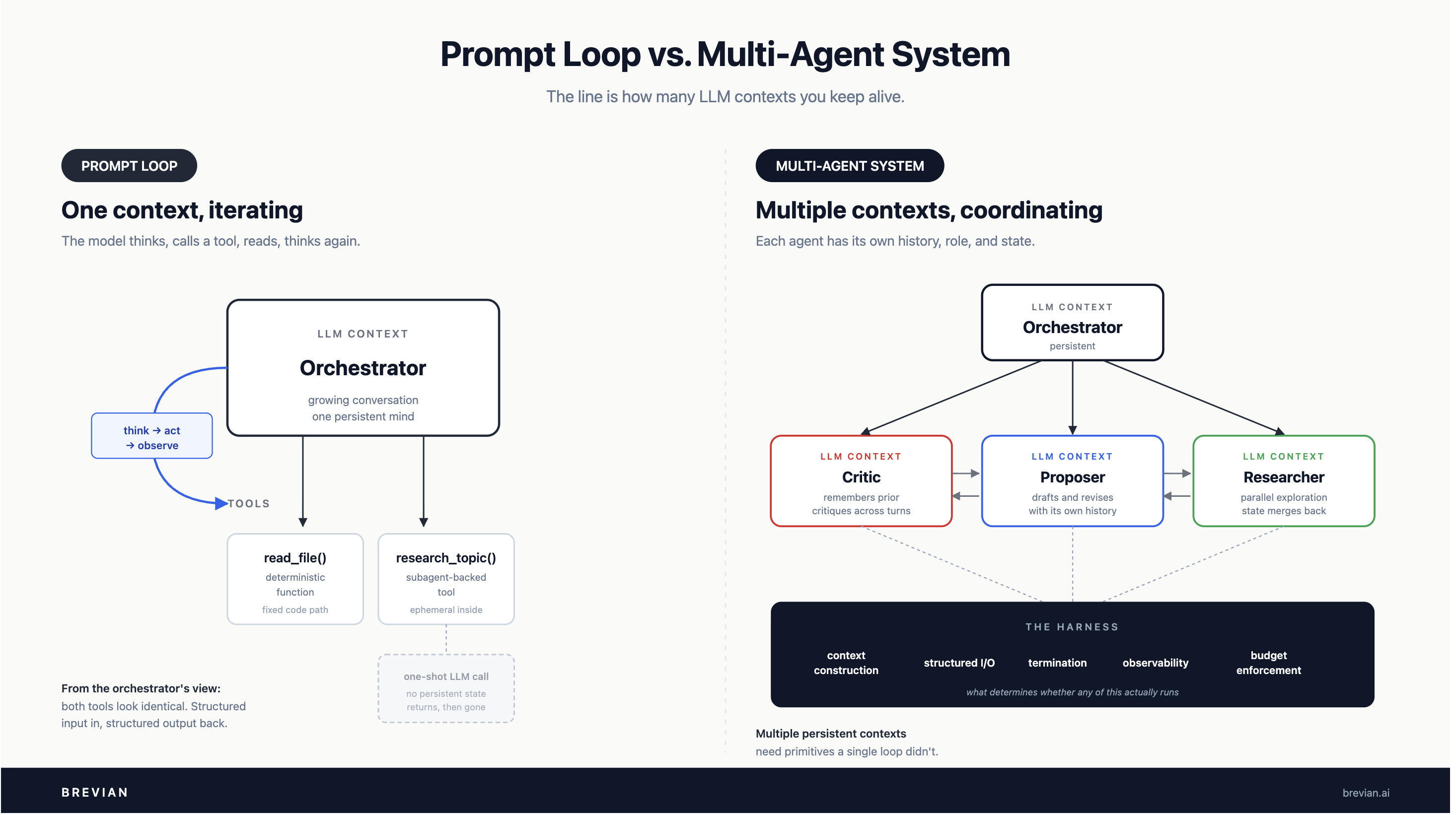
From Prompt Loops to Multi-Agent Systems: Why the Harness Matters
Where the line between a prompt loop and a multi-agent system actually sits, and what that implies for the harness you have to build underneath.
Introducing Brevian MCP: Ask Your Sales Data Anything
New intelligence, synthesized from every layer of your sales data, delivered as operational playbooks you can act on this week.
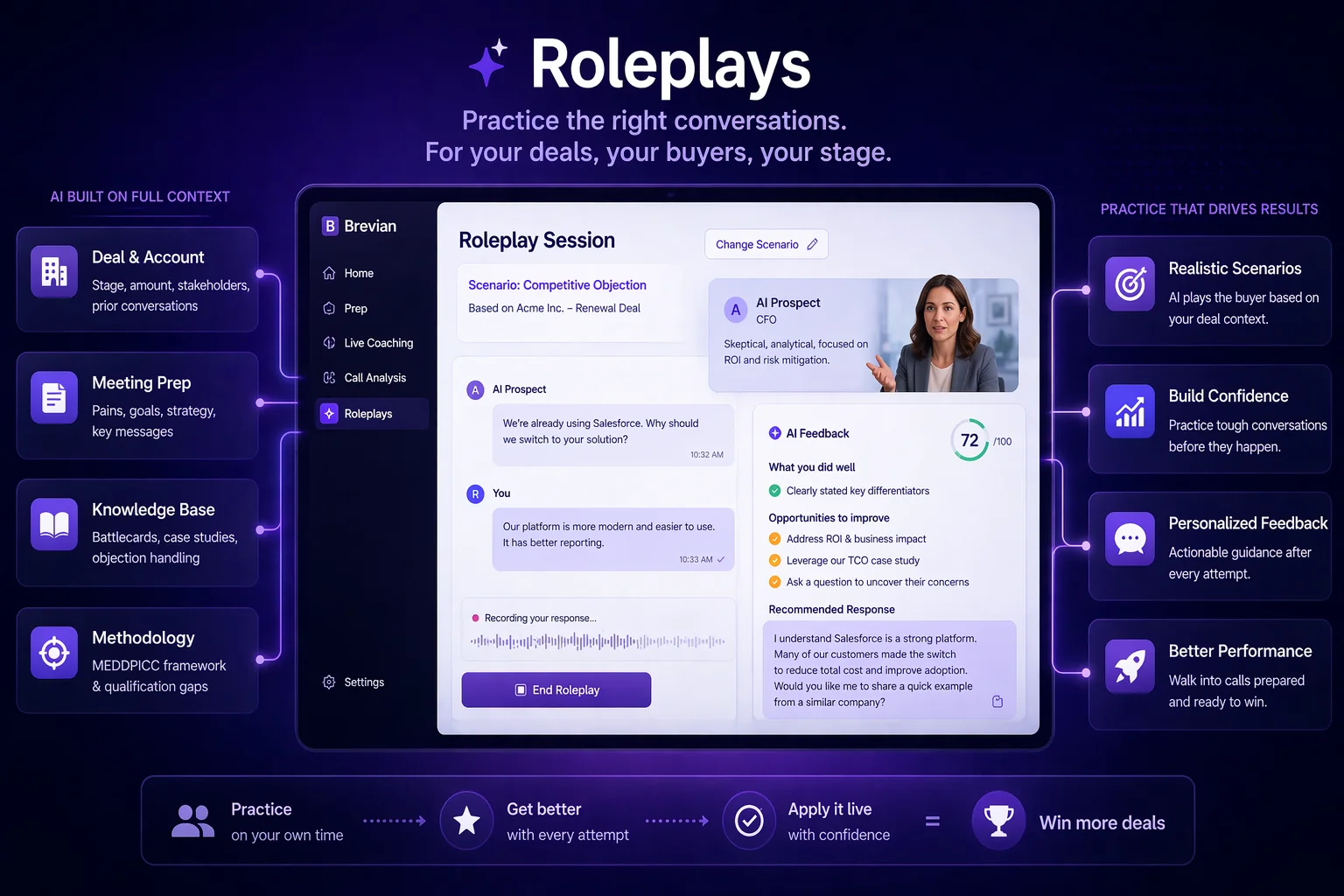
Practice the Call Before It Happens
Every high-performance profession has structured practice. Sales is the exception. Brevian Roleplays let reps rehearse deal-specific scenarios grounded in real context.