Knowledge Engine vs. Conversation Intelligence
.webp)
Most sales managers have more call recordings than they have time to watch. That is not an information problem. It is a structure problem.

Most sales managers have more call recordings than they have time to watch. That is not an information problem. It is a structure problem.
The conversation intelligence pitch to sales managers has always been visibility. Record every call, transcribe it, score it, surface the themes. Know what your reps are saying, how deals are progressing, which objections keep coming up. After years of that promise, most sales managers have more data than they have ever had and still walk into pipeline review relying on the same thing they always have: their reps telling them where things stand.
The data is there. The problem is that conversation intelligence tools generate it in a form that requires a manager to do all the interpretive work themselves. A transcript tells you that a prospect mentioned budget constraints on Thursday. It does not tell you whether that changes the close probability, whether the rep followed up on it, whether it connects to a risk pattern you have seen in three other deals this quarter, or what your rep should do about it before next week's call. Surfacing information is not the same as making it actionable, and that gap is where most sales managers are still operating entirely on their own.
What a knowledge engine is, and what separates it from conversation intelligence, comes down to a single distinction: conversation intelligence captures what happens in meetings, while a knowledge engine connects that information to everything else that matters for the deal.
Brevian's Knowledge Engine builds a structured graph across every layer of your go-to-market. The nodes are the entities your sales team works with every day: products, features, use cases, customer pain points, personas, objections, competitors, stakeholders, and proof points. The edges are the relationships that make those nodes useful in combination: a feature addresses a specific pain, a use case maps to a buyer persona, a product has an advantage over a competitor, an objection has a proven rebuttal, a case study outcome is relevant to a particular buyer type. When your team adds product documentation, battlecards, or case studies, Brevian processes them to extract and populate those relationships. Transcripts add a live layer on top, mapping what prospects actually said onto that structure: which pains this customer surfaced, which use cases the rep suggested, which discovery areas went uncovered.
The result is not a collection of documents that can be searched. It is a connected map of your product, your customers, your competitive landscape, and your deal history, structured in a way that lets the engine reason across all of it simultaneously and produce outputs a sales manager can actually use.
What that means practically starts with pipeline review. When a manager looks at a deal in Brevian, they are not reading a transcript or a rep's CRM notes. They are seeing a structured assessment: which qualification dimensions have been confirmed in conversation and which are still gaps, what risks have been flagged across engagement, competition, timeline, and champion health, and what the rep has and has not covered against your methodology. A manager can review a ten-deal pipeline in the time it used to take to watch two call recordings, and what they see is organized around decisions rather than events.
Methodology enforcement follows the same logic. Most sales organizations run MEDDPICC, BANT, or a custom qualification framework. Conversation intelligence records the calls where that methodology is supposed to be applied. The Knowledge Engine audits every deal against your framework automatically, maps what has been confirmed in conversation against the qualification dimensions your process requires, surfaces the gaps, and generates the specific questions a rep needs to ask to fill them. A manager no longer has to listen to calls to find out whether their reps are running the process. The gaps surface across the pipeline view, and the reps receive targeted questions in their pre-meeting briefings before each conversation. The methodology moves from the training deck to every meeting without any review cycle sitting in between.
Coaching gets more targeted for the same reason. When a manager can see, across all deals, that paper process is consistently unconfirmed at stage three, or that a specific competitive objection keeps appearing without a structured response, that is a coaching signal derived from evidence rather than impression. The knowledge graph connecting transcripts to qualification frameworks to deal outcomes makes those patterns visible in a way that reviewing individual calls never could.
The clearest way to see the difference is in a scenario every sales manager knows. Your rep has a second call with a mid-market account. The champion is engaged, a technical buyer appeared on the last call, and the prospect mentioned during discovery that their current tool has a data quality problem they have been trying to fix for two quarters.
With conversation intelligence, your rep has a transcript. They can search it for the data quality mention, review the summary, maybe pull up the stakeholder list if the tool produces one. They will spend twenty or thirty minutes doing that prep manually, and what they produce reflects whichever sources they remember to check. The manager has no visibility into whether that prep happened at all.
With Brevian's Knowledge Engine powering Meeting Prep, the rep opens the meeting and finds a briefing that has already done all of that work. The data quality pain is connected to the specific product capability that addresses it and the case study that proves it in a comparable account. The technical buyer who appeared last call is flagged as a potential blocker based on their role and the fact that the champion has not mentioned them before. The MEDDPICC audit shows that budget and paper process are unconfirmed, and the briefing surfaces targeted questions to fill those gaps, informed by what is already known rather than pulled from a generic template. The deal risk section flags that the opportunity has been in the current stage eighteen days longer than your team's average and recommends a concrete next step to advance it before the call ends.
The manager, meanwhile, can see all of that before the call happens. If the rep is about to walk into a high-value conversation without a confirmed economic buyer and a new technical stakeholder on the invite, that is visible in the pipeline view with enough time to do something about it.
Sales Managers stop auditing calls to find out whether their methodology is being followed and start using their time on deals that actually need intervention. RevOps and Enablement teams see, in real time, which qualification dimensions are consistently missing across the team and which product capabilities are being mapped to customer pain accurately versus going unmentioned. AEs and SEs walk into every conversation with a structured plan rather than a collection of notes assembled from five different tabs in the last thirty minutes before the call.
Because Brevian's Knowledge Engine is the foundation that powers Meeting Prep (pre-meeting intelligence), Live Assist (real-time guidance during calls), Sales Coaching (post-call analysis and rep development), and CRM Updates (automated data hygiene), every touchpoint in the sales cycle draws from the same connected structure. The intelligence does not restart at each meeting. It compounds across the entire engagement, so a pain point surfaced in week one informs the demo in week three, the objection handling in week five, and the close strategy in week eight.
That is what conversation intelligence was never designed to do, and it is why adding more recording, more transcription, or more summary capability does not close the gap. The constraint is not data volume. It is whether the data is organized into a connected structure that reasons across dimensions and produces forward-looking action for managers and reps alike, not just backward-looking documentation.
If your team already uses a conversation intelligence platform, Brevian can ingest your existing transcript data and fold it into the Knowledge Engine alongside your CRM, your product documentation, and your methodology. Conversation intelligence records what happened. A knowledge engine determines what it means and what to do next.
You can request a demo to see how it works with your deals, your methodology, and your team.
Brevian is the knowledge-powered sales intelligence platform that bridges the gap between product innovation and sales execution. Learn more at brevian.ai.
FAQ
What is the difference between a knowledge engine and conversation intelligence?
Conversation intelligence tools record, transcribe, and summarize sales calls. A knowledge engine connects that conversation data to product knowledge, CRM context, and sales methodology to produce structured, forward-looking intelligence that tells managers where deals stand, where reps are unprepared, and what needs to happen before the next call.
What does Brevian's Knowledge Engine actually do?
Brevian's Knowledge Engine processes your product documentation, battlecards, playbooks, CRM data, and meeting transcripts to build a connected map of relationships between products, features, pain points, use cases, objections, and personas, then uses that structure to power pre-meeting briefings, qualification audits, deal risk assessments, and coaching signals.
Can Brevian work alongside a conversation intelligence platform like Gong or Chorus?
Yes. Brevian can ingest existing transcript data from conversation intelligence tools and map it into the Knowledge Engine. The two serve different functions: conversation intelligence captures what was said, and Brevian determines what it means for the deal and what the manager and rep should do next.
How does a knowledge engine improve sales methodology adoption?
Rather than relying on call reviews to enforce frameworks like MEDDPICC or BANT, Brevian's Knowledge Engine audits every deal automatically, maps confirmed information against your qualification dimensions, and generates targeted questions to fill gaps before each call, so methodology enforcement happens before the meeting rather than after.
Who benefits most from a knowledge engine approach?
Sales Managers gain structured pipeline visibility and methodology enforcement without auditing calls. RevOps and Enablement teams see consistent patterns in qualification gaps and product positioning across the team. AEs and SEs receive pre-built strategic briefings instead of spending thirty minutes on manual pre-call research.
If you liked this, you might want to read
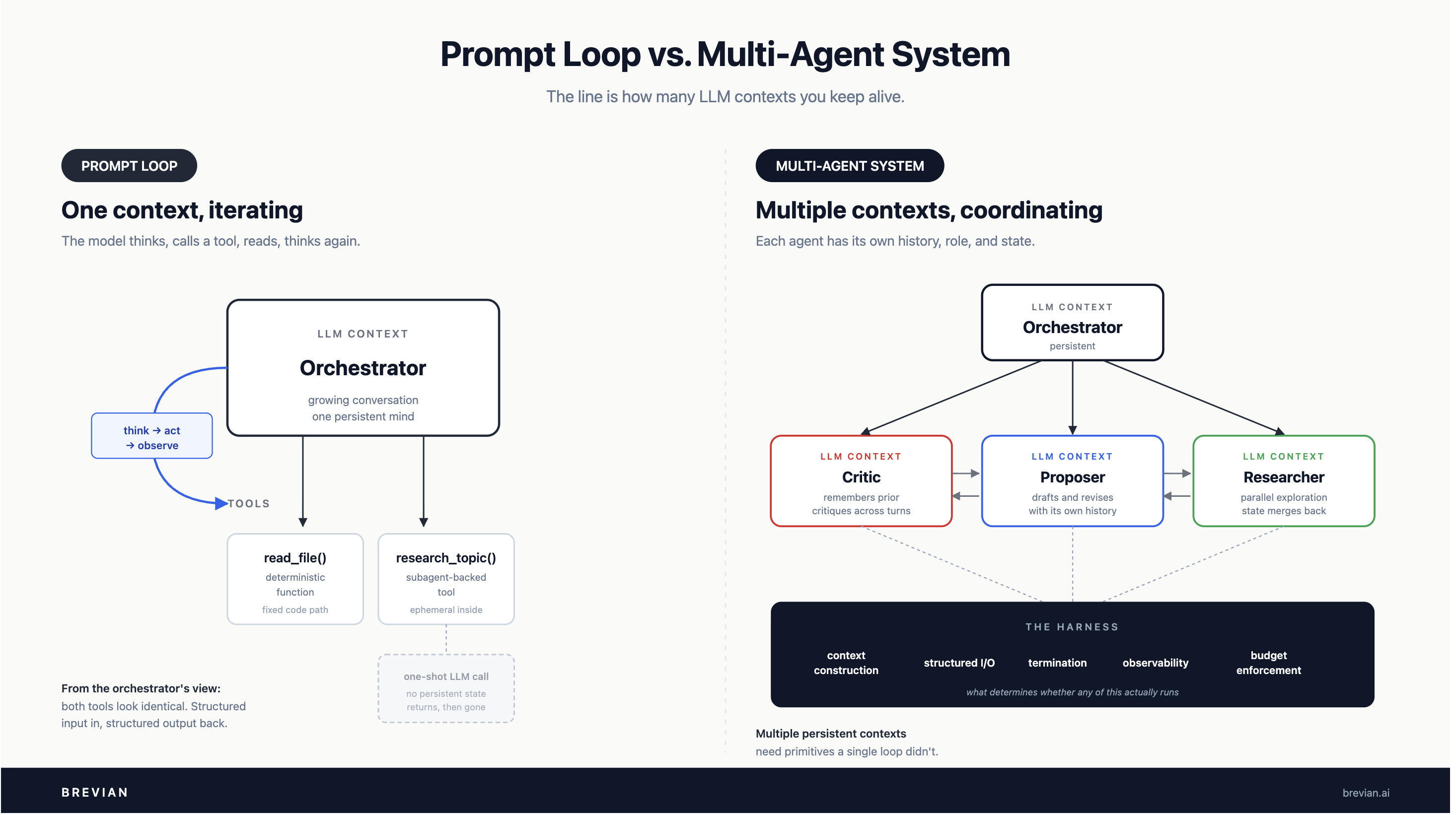
From Prompt Loops to Multi-Agent Systems: Why the Harness Matters
Where the line between a prompt loop and a multi-agent system actually sits, and what that implies for the harness you have to build underneath.
Introducing Brevian MCP: Ask Your Sales Data Anything
New intelligence, synthesized from every layer of your sales data, delivered as operational playbooks you can act on this week.
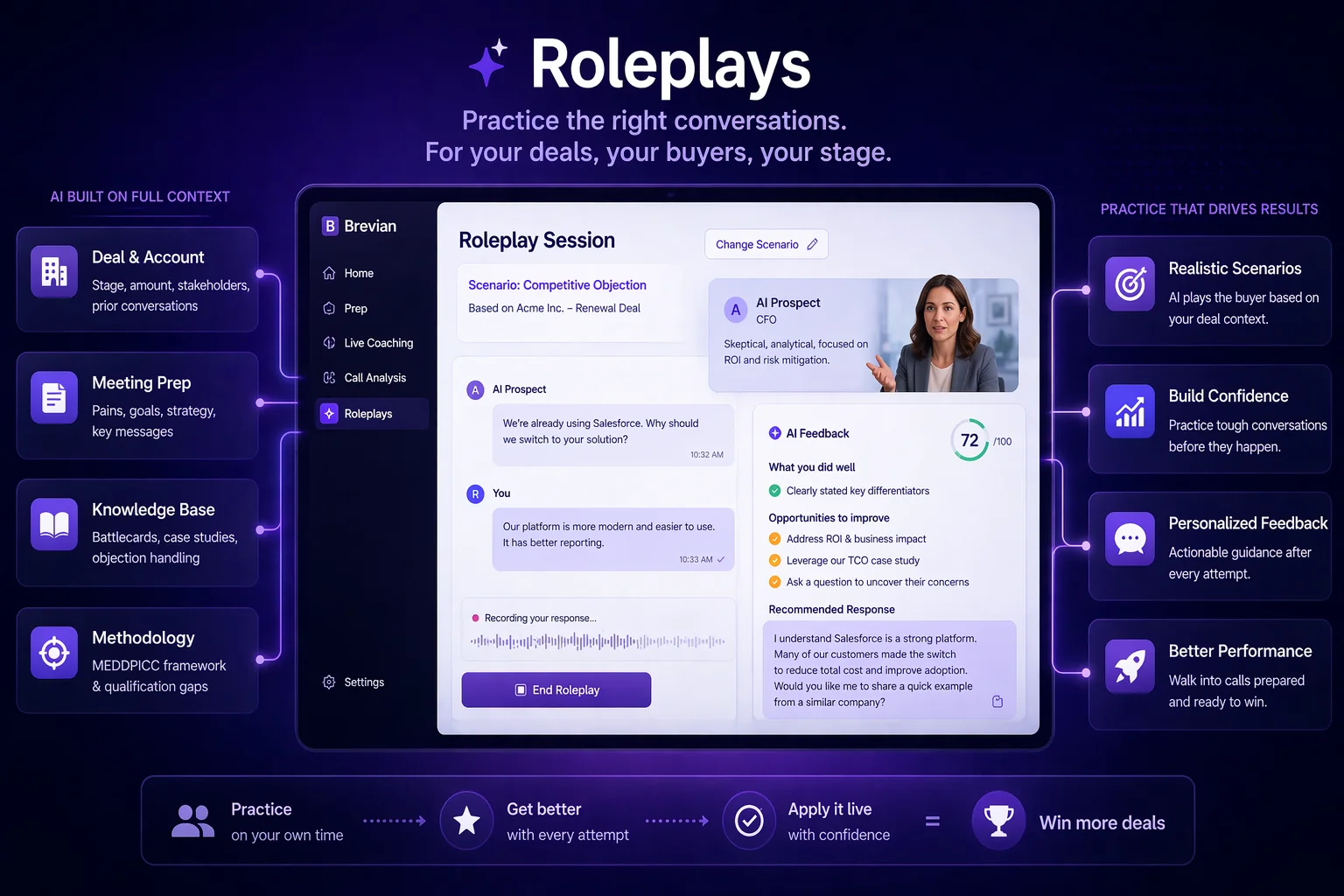
Practice the Call Before It Happens
Every high-performance profession has structured practice. Sales is the exception. Brevian Roleplays let reps rehearse deal-specific scenarios grounded in real context.