The technical expert on every discovery call.
Brevian's AI sales engineer joins the call as a participant, listens to the conversation, and answers technical questions the moment it's asked to — trained on every feature, integration, use case, and pricing model you have. No ramp time. No scheduling. No "I'll get back to you."
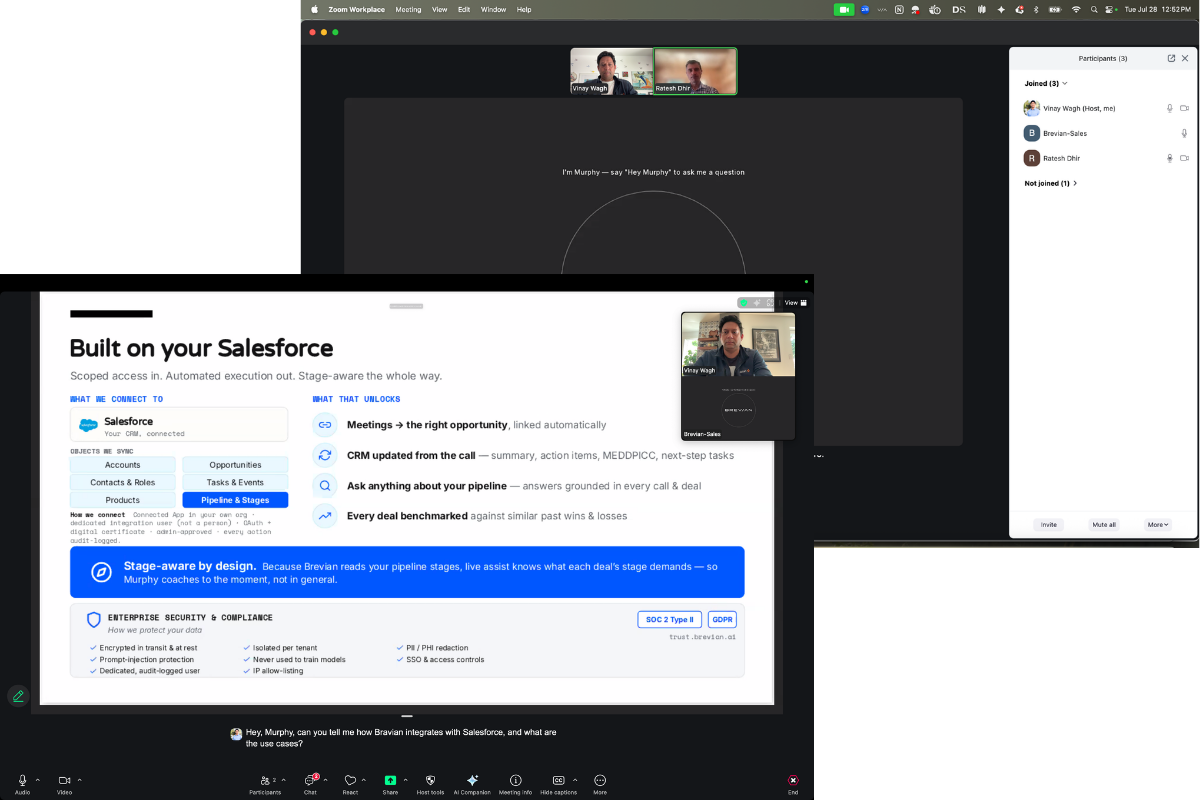
What is an AI sales engineer?
An AI sales engineer — also called a virtual sales engineer — is software that joins a live sales call as a voice participant and answers the customer's technical and product questions in real time, using the vendor's own product documentation, enablement content, and deal context as its source of truth. Unlike a rep-facing assistant, which surfaces answers privately for a human to relay, an AI sales engineer speaks to the customer directly, and can ask the technical qualification questions needed to determine whether the product is actually a fit.
Brevian's AI sales engineer runs on the same knowledge graph that powers Live Assist, CRM Updates, Sales Coaching, and Insights. It has full context on your products, the account, the deal, the meeting, and the rep — and it operates inside the call rather than reporting on it afterward.
It appears in the participant list under a name you choose. Nothing hidden.
A wake phrase brings it in. It never interjects on its own.
You control which knowledge it draws on and which topics it will answer.
Product velocity has outrun the human ability to keep up.
New reps take months to ramp, and even after they do, almost none retain every detail across a broad or fast-moving product line. Releases ship faster than enablement can document them. The result is familiar: a customer asks one specific technical question, the rep doesn't have the answer, and the deal pauses while a sales engineer gets scheduled into a follow-up call — assuming one is available in that region, in that language, that week.
Two shifts changed what's possible. Voice models became good enough for natural, real-time conversation. Reasoning models became reliable when grounded in the right context. Together they make an AI participant on a live customer call viable in a way it wasn't eighteen months ago.
And the knowledge doesn't go stale. When you ship a feature, publish a release note, or add an integration, Brevian ingests it automatically. The AI sales engineer is current on your product the day it changes — not a quarter later, when enablement catches up and someone schedules the training.
One SE for every four reps. Or eight. Or ten.
Almost no company staffs a sales engineer per rep. Most spread one SE across four to ten AEs, which means the SE is triaged onto the calls that look most likely to close — and absent from most discovery calls, where technical confidence is actually won or lost.
That isn't a staffing oversight. It's arithmetic. A revenue budget splits between quota-carrying reps and non-quota-carrying SEs. Staff more SEs, engage them earlier, and win rates go up. But every SE you hire is a dollar not spent on someone carrying a number.
So the choice is: more reps at a lower win rate, or fewer reps at a higher one. Where you land depends on your ACV. Either way, you're trading something away.
More pipeline coverage
Win rate on technical deals
Higher win rates on technical deals
Quota-carrying capacity
SE-level coverage on the calls that matter
Nothing on either side of the budget
Cost aside, would having a sales engineer on every discovery call help your reps close faster? Every revenue leader answers yes. The cost is the only reason the answer has ever been no.
Brevian removes the trade-off. An AI sales engineer can learn everything about your products and be effective on the critical early calls where expert involvement lifts win rates — and because it's software, it's available in any geography, at any hour, in any language, across thousands of simultaneous meetings. No hiring lead time. No ramp.
"At Databricks, every AE had the luxury of their own sales engineer. Most companies can't afford that — so they spread one SE across too many reps and delay the conversation. I wanted to fix that."

It behaves like a participant, not a command line.
The difference between a useful AI on a call and an intrusive one comes down to conversational manners. Brevian's AI sales engineer is built to have them.
A named participant on Zoom, Microsoft Teams, Google Meet, and Webex.
Because it speaks out loud, the AI sales engineer joins the call and appears in the participant list like any other attendee. You choose its name and how it presents itself — an avatar, your company logo, or a simple image. Most teams choose a logo, which reads more clearly as a helpful system than as a person.
.png)
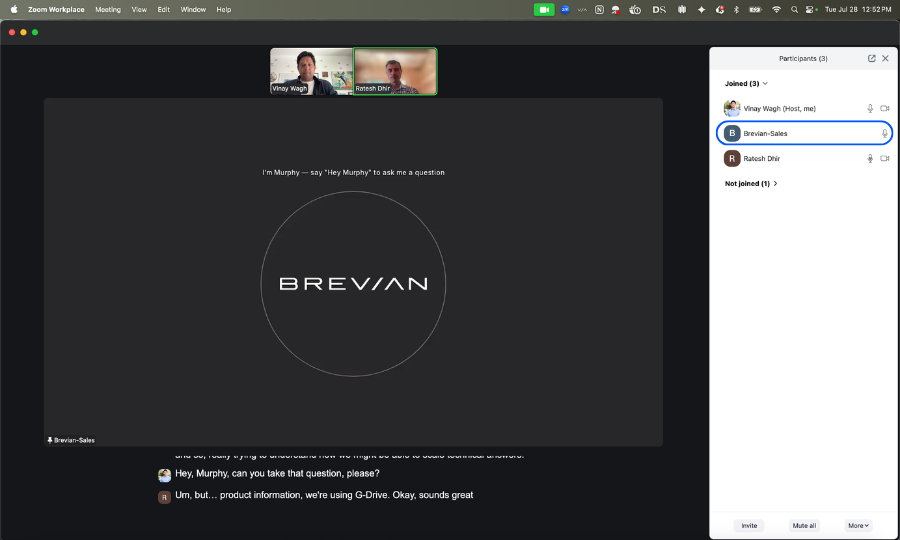
A wake phrase brings it in. Nothing else does.
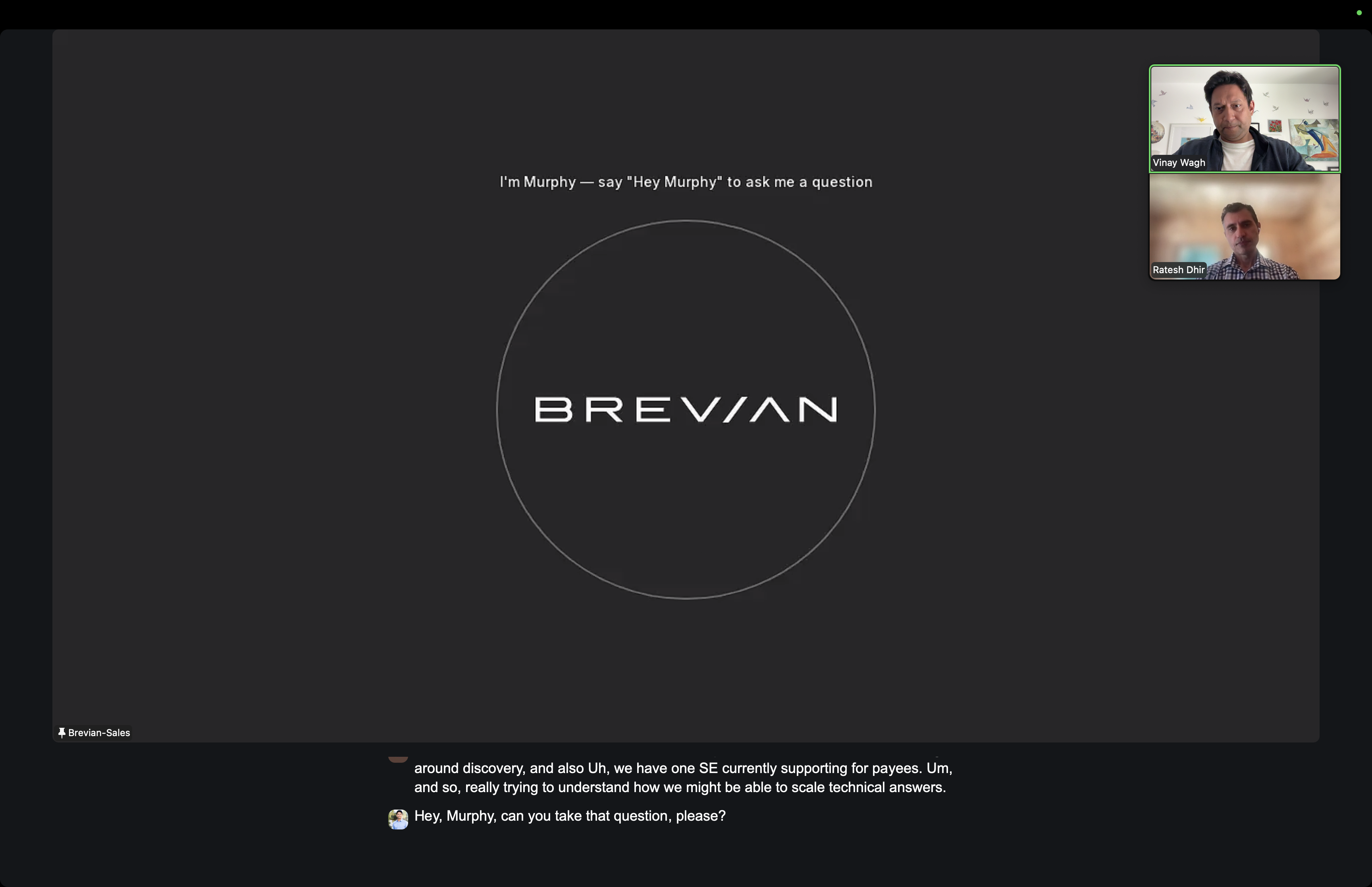
The AI sales engineer never interjects on its own. A rep or a customer addresses it by name — "That's a question for you, Murphy" — and it answers. Once it's engaged, follow-up questions don't need the wake phrase again; it stays in the flow of the exchange the way a person would, then steps back out.
It asks the technical questions a rep often can't.
Ask a strong human SE "what compliance standards do you support?" and they won't recite a list — they'll ask which standards matter to you, then answer precisely. The AI sales engineer does the same: it narrows before it answers, and runs the technical discovery that determines whether there's a fit. This is the part reps without deep product knowledge can't do, and it's what separates an expert on the call from a search box.
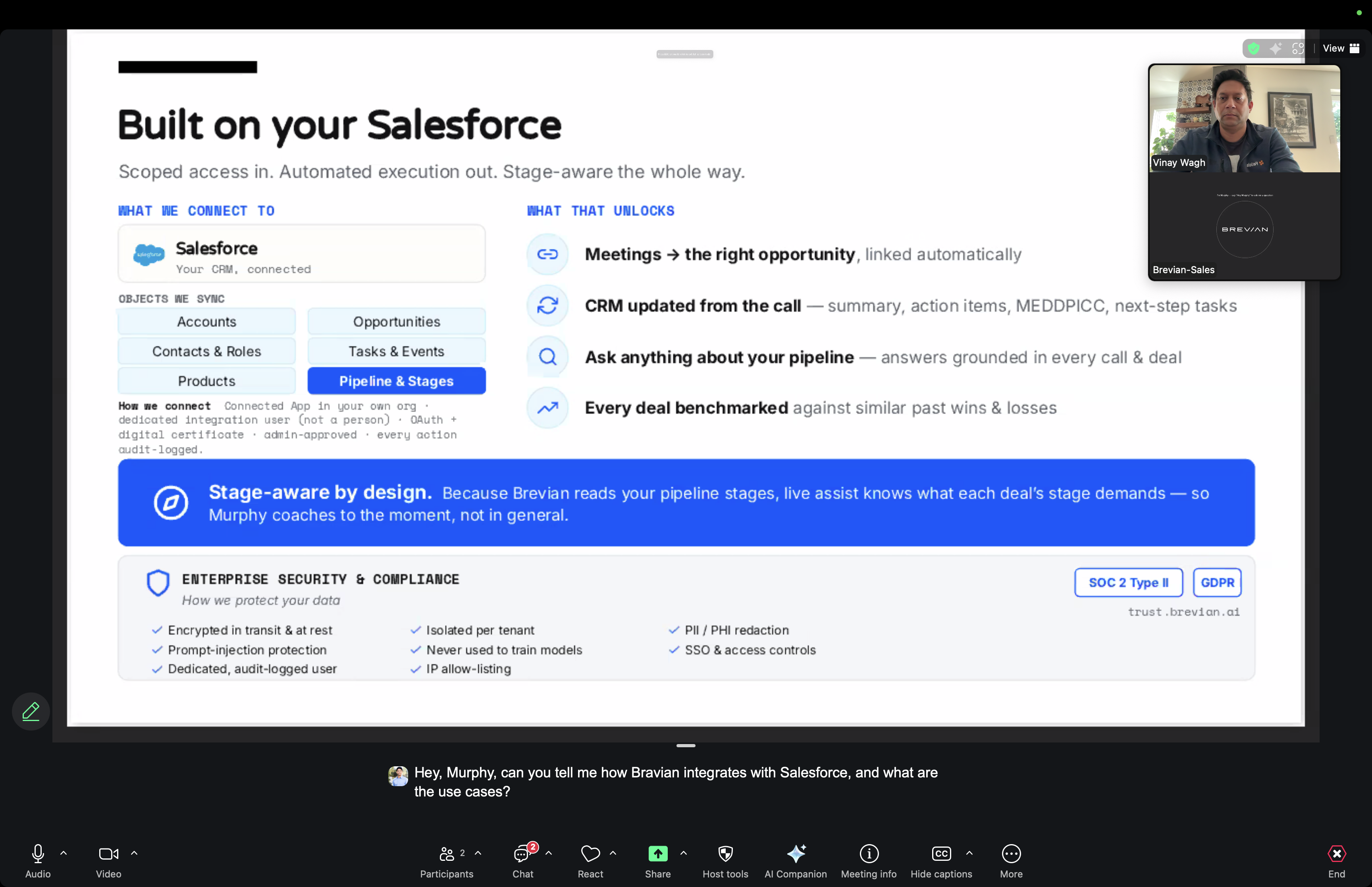
It brings up the right slide, live.
When an answer is better shown than described, the AI sales engineer can pull up and present the relevant slide during the call — without the rep hunting for it or promising to send something over later.
You decide what it knows, and what it will talk about.
An AI on a customer call is only as safe as the constraints around it. Brevian's are explicit and yours to set.
You choose which knowledge the AI sales engineer is allowed to draw on. Build one scoped to a single product line, or one tuned to a specific sales play. Its range is deliberate, not open-ended.
The prompt is fully configurable, including an allow-list of topics. Restrict it strictly to technical, product, and integration questions — or open it wider. Brevian helps you configure it to your sales play.
It answers from your enablement content, the same source of truth your reps and SEs work from, with guardrails against answering questions it can't ground.
It knows the rep, the meeting, the account, and the deal — because it runs on the same knowledge graph as the rest of the platform.
An objection handled well in EMEA is available on the next North America call. One shared knowledge graph means a win anywhere becomes an answer everywhere.
"Do we really want an AI talking on our customer calls?"
It's the first question every team asks, and it deserves an answer rather than a reassurance. There is a real adjustment period. Here's how teams get through it.
Something like: "We've got an AI on the call that's plugged into our product knowledge - it may help with detailed questions, which saves us scheduling a follow-up." Set the expectation in the first minute and it reads as preparation. Spring it on someone in minute twenty and it reads as a trick.
Internal meetings and low-impact conversations first. Build the team's comfort and skills using it before it's on a deal that matters. And skip the human-looking avatar — a logo reads as a system doing its job, and removes the "wait, is that a real person?" question entirely.
Handing a technical question to the AI is the same move as handing it to an SME who's on the call — something buyers have been comfortable with for decades. The difference is the AI is on every call, not just the ones an SE could be scheduled into.
See it on one of your own calls.
The fastest way to judge an AI sales engineer is to watch it handle your product's technical questions. Book a demo and we'll run it against your real use cases.
Two layers on the same call. One coaches the rep. One talks to the customer.
Live Assist and the AI sales engineer run on the same knowledge graph and often run on the same call. They do different jobs.
Live Assist coaches your rep silently. The AI sales engineer speaks to the customer directly. A human SE does the same job — but only on the calls you can staff them on and in the languages they can speak.
The sales engineer is where the economics are clearest — but the pattern isn't specific to presales. Any call where one specialist's knowledge is the bottleneck, from security review to implementation scoping to renewals, is the same problem. This feature can be configured to handle any of them.
An AI tool that just answers questions is a feature. Winning the call takes a system.
A standalone AI that joins calls and answers technical questions is useful. But on its own it pushes reps toward a bad habit: redirecting every hard question to the AI instead of getting better at the conversation. Great discovery isn't the AI doing the talking — it's a prepared rep who handles breadth and depth themselves, and brings in the expert when the moment actually calls for it.
It's one layer, not the whole answer
Brevian pairs the AI sales engineer with Live Assist coaching the rep in real time and roleplay-based prep. The rep is equipped to run great discovery themselves — and brings in the AI sales engineer for the technical depth that genuinely needs it. A point solution gives you the AI and nothing to make the rep better around it.
It walks in already knowing the deal
Because it runs on the same knowledge graph as the rest of the platform, Brevian's AI sales engineer has the full account and deal history going into the call — the risks, the past objections, where the deal actually stands. A standalone tool joins cold: it may know your product docs, but not this account, this deal, or what was said last time.
It stays current as the deal moves
Context isn't loaded once. Every call, every new objection, every change to the account feeds back into the knowledge graph, so the AI sales engineer walks into each call knowing where the deal actually stands today. Keeping a point tool — or a human expert — that current on every deal is manual work almost no team sustains.
What teams ask before they buy
How the AI sales engineer works on a live call, what you control, and how it fits alongside your team.
An AI sales engineer is software that joins a live sales call as a voice participant and answers the customer's technical and product questions in real time, grounded in the vendor's own product knowledge. It can also ask technical qualification questions to determine whether the product is a fit.
Yes. "AI sales engineer", "virtual sales engineer", "AI subject matter expert", and "AI SME on the call" all describe the same capability. Brevian uses them interchangeably.
No. Live Assist coaches the rep silently. The AI sales engineer speaks to the customer directly. They share the same knowledge graph and often run on the same call.
Zoom, Microsoft Teams, Google Meet, and Webex.
No. It only responds when addressed by a wake phrase — its configured name. Follow-up questions in the same exchange don't require the wake phrase again.
Yes. The name is fully configurable, and you choose whether it presents as an avatar, your logo, or a simple image. Most teams choose a logo.
Any language. The same expert can be available in every region simultaneously, in the local language.
Yes. The prompt is fully configurable, including a topic allow-list and style guardrails, and you choose which knowledge it can draw on. You can scope an AI sales engineer to a single product line or a specific sales play.
It typically takes just a few days. We will use your products docs and whatever else you would use to train a new SE, do a little fine tuning, and it is ready for testing and final adjustments.
Automatically. When you publish a release note, ship a feature, or add an integration, Brevian ingests it — so the AI sales engineer is current on your product the day it changes, with no retraining cycle and no enablement lag.
It answers from the same enablement content your reps and SEs are trained on, with guardrails against answering questions it can't ground. You can test it as much as you want before enabling it on a live call.
We'll look your meeting volume and price it out but it's a fraction of what you'd pay for SE's to support your team 1:1.